There are grown men I meet on their days off who dress brilliantly in their own clothes, yet the moment they put on a suit, I can’t help thinking, “…what a waste.”
I’ll admit it: on my own days off, I love wearing lots of colour in my casual clothes. A bright pop on my trainers, a few accessories layered together. As a man, I understand all too well the urge to have fun with colour.
Which is exactly why it’s so tempting to keep adding colour when you put on a suit. But the world of suits is the opposite of casual wear. It’s all about the art of subtraction.
If you keep adding colour the way you would with casual clothes, the outfit loses its unity, the eye gets pulled in every direction, and suddenly it all looks cheap. The golden rule for a grown man’s suit is “no more than three colours across your whole look”. And there’s one more thing: a mathematical rule for the tie and the lapel that instantly sharpens the area around your chest, the V-zone.
Match your tie to your suit’s lapel width, and everything falls into place
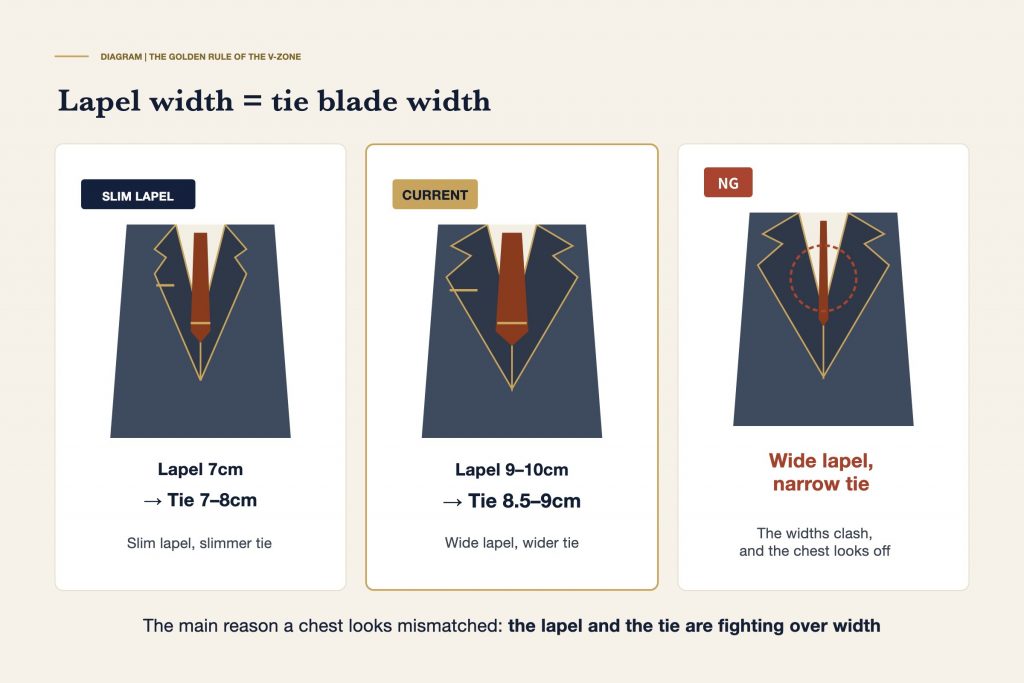
“I never know what to go by when I’m choosing a tie.” If that sounds like you, here is the simplest and most powerful answer I can give you as a tailor.
“Match the width of your jacket’s lapel to the width of your tie’s blade (its widest part).”
That’s all there is to it. Do just this, and your V-zone comes together remarkably well.
- If your lapel is 7cm ➔ go for a tie blade of 7–8cm
- If your lapel is 9–10cm, as most are today ➔ go for a wider tie, around 8.5–9cm
The main reason the chest of a suit looks mismatched is that “the lapel and the tie are fighting over width”. In fact, a look at the tie counter tells you exactly where the trend is. When the shelves are full of wide-bladed ties, it means wide lapels have become the norm for suits everywhere.
But this is where the biggest trap in choosing a suit lies. Follow the trend too closely and you end up looking mass-produced, just like everyone else, which is the opposite of stylish.
Why a suit made six years ago hasn’t aged a day
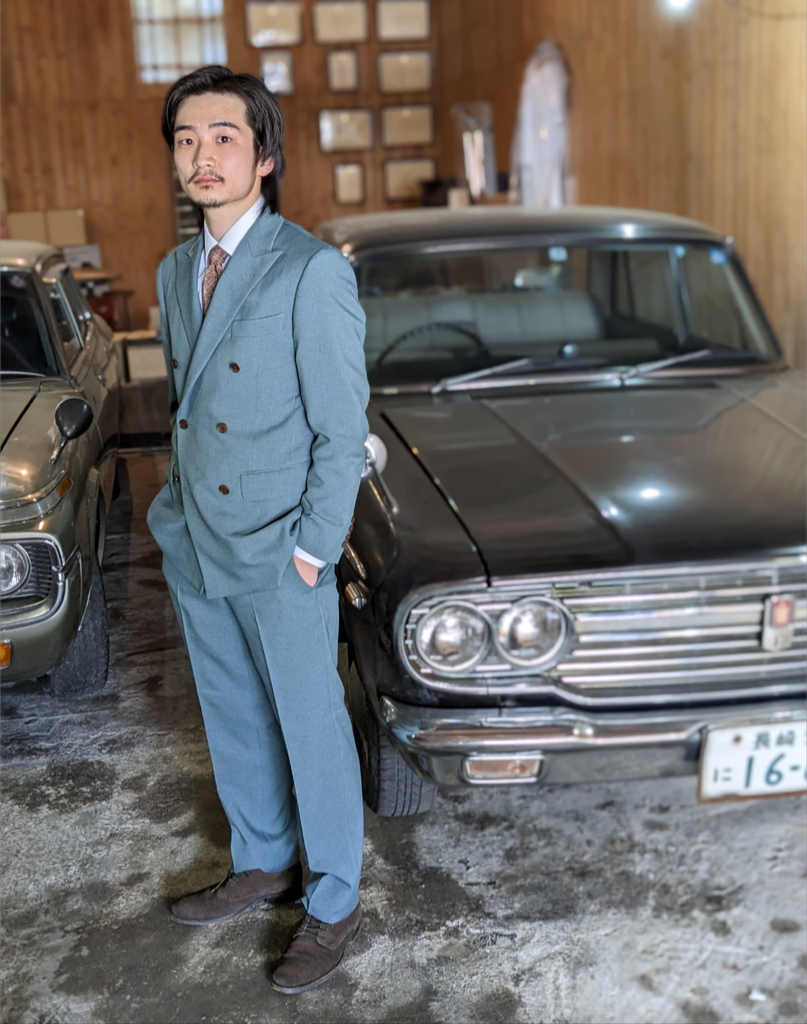
Take a look at this customer’s double-breasted suit. I actually tailored it six years ago, in 2021, and the photos were taken back then too.
Do you remember what suits were in fashion at the time? That’s right: it was the height of the slim suit, with cropped trousers that showed the ankle, skin-tight slacks and narrow lapels.
But this customer told me: “I couldn’t care less about trends. I want you to make the truly great suit I can picture in my head.”
From there, the two of us went back and forth, trading ideas and arguing over every detail, until we’d shaped exactly this suit.
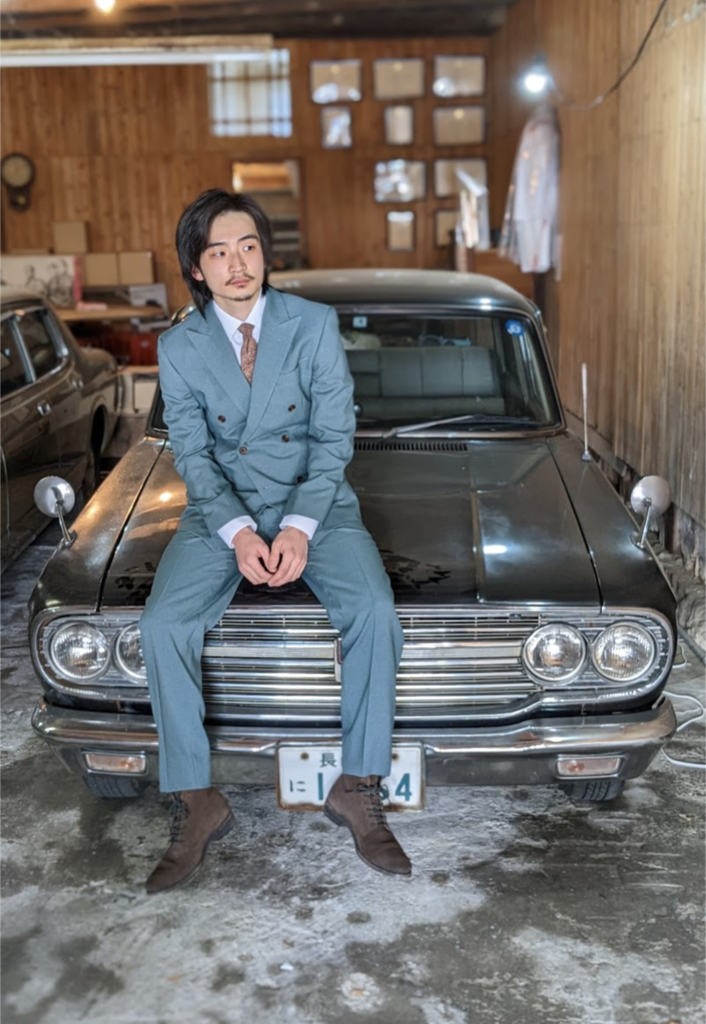
- Colour by subtraction: a subtly toned navy-blue suit with a white shirt, and the tie, shoes and buttons all kept in browns (three colours or fewer in total).
- A balanced V-zone: bold, wide peaked lapels paired with a classic tie of just the right width.
- Just enough ease at the feet: rather than anything too stiff, characterful brown suede boots that blend into the atmosphere of the classic car.
Six years on, how does this photo look to you? Far from dated, you could tell people it was made last week and no one would doubt you, and it gives off an overwhelming charisma and presence.
This is what it means to ignore the trends and have a style of your own.
“A tailor who can do everything can’t really do anything”
If you want to create a style that’s truly your own like this, I’d love you to dive into the world of made-to-measure suits. But there’s one reality about choosing a tailor that you absolutely need to know first.
It doesn’t have to be my shop at all. What matters, above everything, is whether your sensibility and the tailor’s are a good fit.
Think about hiring a professional photographer. You might assume that because they’re all professionals, anyone will do. In reality, that’s not the case.
- A photographer who has no equal when it comes to landscapes
- A photographer who’s brilliant at making food look delicious
- A photographer who excels at fast-moving sport
Each has a completely different speciality. Only when the photo you want matches the photographer’s strengths do you get the perfect picture you had in mind.
Tailors are exactly the same. Some shops will say, “We can make anything! From slim, fashion-forward cuts to traditional classics, leave it all to us!” But here’s what I think.
“A tailor who can do everything can’t really do anything.”
Being able to turn your hand neatly to every style also means not having a deep philosophy or aesthetic about any of them.
Why I don’t recommend slim suits to my customers
I’ll be honest with you. Skin-tight slim suits are not my strong point.
Technically, of course, I can make one. You draft a slim pattern and sew it narrow, so as a professional, if you asked me to, I could. But I never wear slim suits myself. I can’t stand in front of a valued customer and proudly tell them “this is the best there is” about clothes I don’t truly love and don’t wear myself.
What I’m genuinely best at, and what I love more than anything, is the classic style of the 1950s.
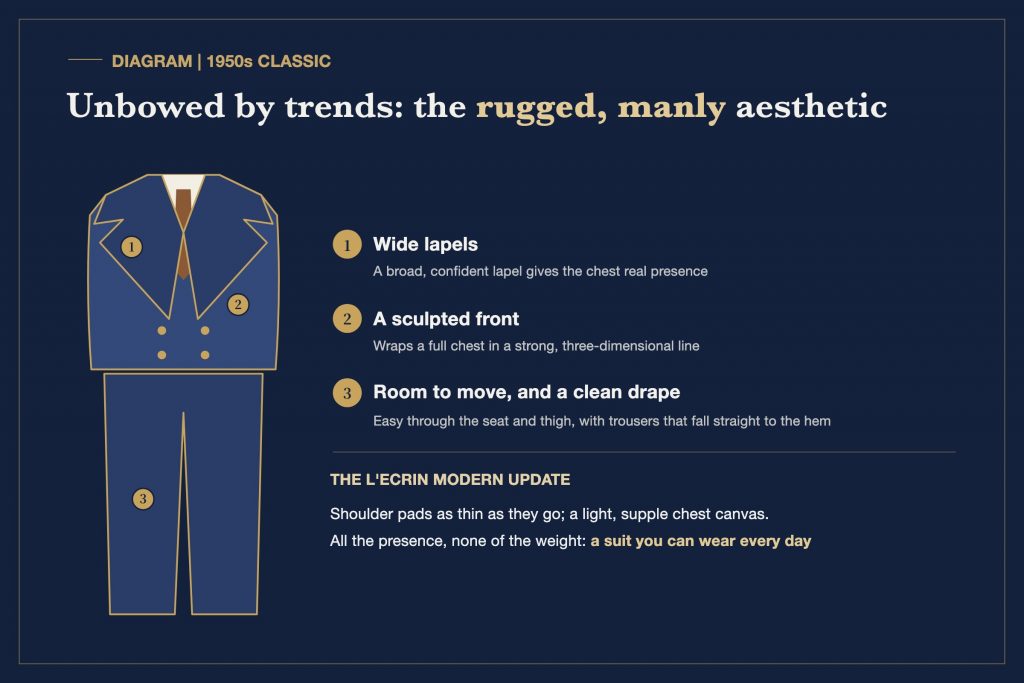
It has a weight and a masculine dignity that a merely slim suit can never imitate. The classics of the fifties are packed with a timeless, overwhelming allure that deserves to be called the very essence of a man.
But this is where a tailor really has to show his skill.
If you reproduce a vintage suit exactly as it was, with the original patterns and construction, the shoulders end up far too stiff and heavy, and it becomes nothing more than a frumpy, old-fashioned costume.
The classic style I make isn’t simply old clothes born of nostalgia.
- I switch to thin shoulder pads
- I choose a light, supple chest canvas that moves with the body
The wide, imposing look and the rugged, manly silhouette stay exactly as they are, while the hidden canvas and shoulder construction are updated with today’s lighter techniques.
It’s these small, invisible adjustments that stop the suit feeling like heavy armour. You can throw it on easily in everyday life today, and it carries a timeless, grown-up allure with a modern poise.
When a man in his forties or older, who has filled out and gained depth as a person and in life, puts on this classic style, it becomes his own “armour for life”, something that far surpasses any fashionable garment.
In conclusion: don’t chase trends. Stay true to your own style
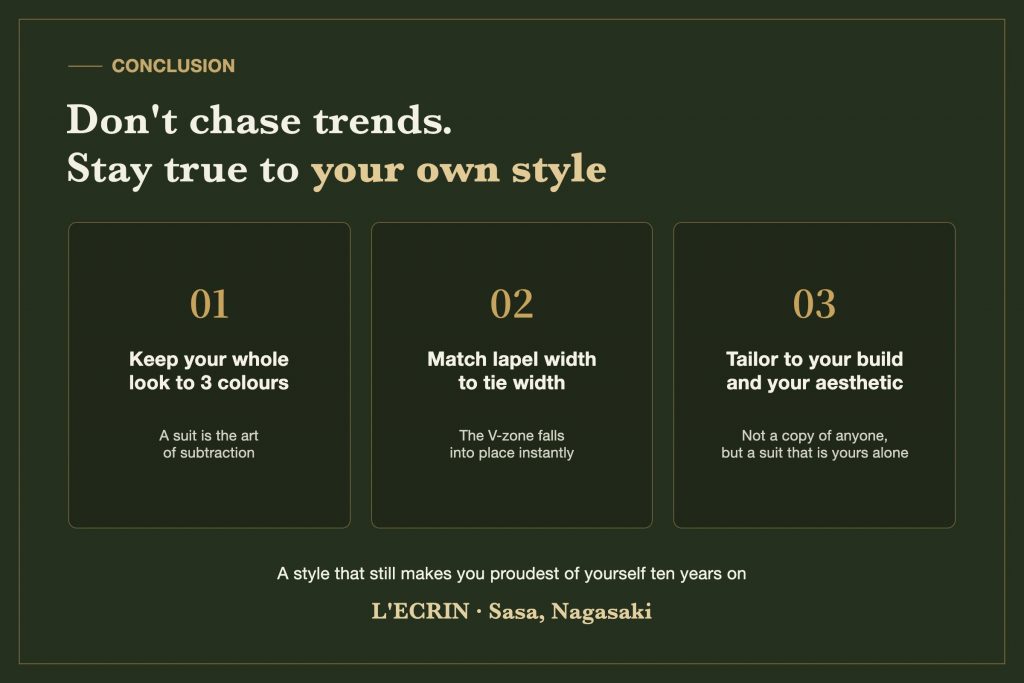
Suit trends change constantly with the times. Slimmer, then wider, jackets shorter, then longer.
Isn’t it time to stop being pushed around by fickle fashion, feeling every few years that the suits in your wardrobe look dated, and buying new ones?
- Pare your whole look down to three colours or fewer
- Keep to the golden ratio of lapel width to tie width
- Don’t copy anyone else. Have a style tailored that fits your own aesthetic
Chasing trends isn’t what makes a man look great. The man who has a style that, ten years on, still makes him look his proudest is the one who looks great in any era.
“I’ve always felt uncomfortable in fashionable slim suits.” “I want to wear a rugged, masculine, alluring classic like the fifties.” “I’m looking for a tailor who’ll build my own style with me, arguing over every detail along the way.”
If that sounds like you, come and knock on L’ECRIN’s door in Sasa, Nagasaki, any time. I’ll put my heart into tailoring a genuine style that’s yours alone, one that doesn’t bow to fashion.
Related reading
The Myth of the “All-Season” Suit: What Cloth Weight Really Tells You, and the Art of the Summer Waistcoat
A suit made to your measurements
Sleeves, trouser hem, jacket length, shoulders and arms are all cut to your own body, not a size chart. Fittings are by appointment only. Tell us the dates you are in Japan and we will propose a time.