Walk into any suit shop and you’ll hear plenty of reassuring phrases.
“This one’s all-season, so you can wear it all year round.”
If convenience and value for money matter to you, that can sound very appealing. The mills have answered that demand too: cloths of around 250–280g are what they supply to the market more than anything else.
But as a man who genuinely loves grown-up clothes, I always tell my customers the truth.
“In Japan’s climate, there is no such thing as one suit that takes you perfectly from the height of summer to the depths of winter.”
Put on a summer cloth and a Japanese summer is still hot. I’ll admit I can’t stand summer myself. Yet if you have a suit made purely in pursuit of “wear it all year”, it ends up half-stuffy in summer and thin and chilly-looking in winter, and the thing that matters most, a grown man’s dignity and allure, quietly slips away.
Whether you run a business or you’re a man who stands up at meetings, ceremonies and the milestones of life, a suit shouldn’t be mere everyday workwear. It should be your signboard, something you put on to wear your pride.
So this time I’d like to talk about the truth behind “all-season”, the secret of the weave hidden behind the cloth-weight figure, and the art of the summer waistcoat that every man who stands in front of others ought to know.
Judge Cloth by the Weight Figure Alone and You’ll Miss the Real Thing
When choosing suit cloth, one common yardstick is its weight: grams per metre of cloth.
- Around 210–240g: spring/summer (light and thin)
- Around 250–270g: mid-season / year-round
- 300g and up: autumn/winter (heavy and substantial)
Catalogues and chain stores tend to tell you that “around 260g is a safe bet”, but there’s a big trap here.
Even with a high (heavy) weight, thanks to a plain weave and the way the yarn is twisted, there are superb cloths made purely for spring and summer that are astonishingly cool in high summer and tailor into a beautifully three-dimensional shape.
Single Yarn or 2-Ply: It Transforms How the Suit Looks
Behind the cloth a grown man should choose lies meticulous craftsmanship.
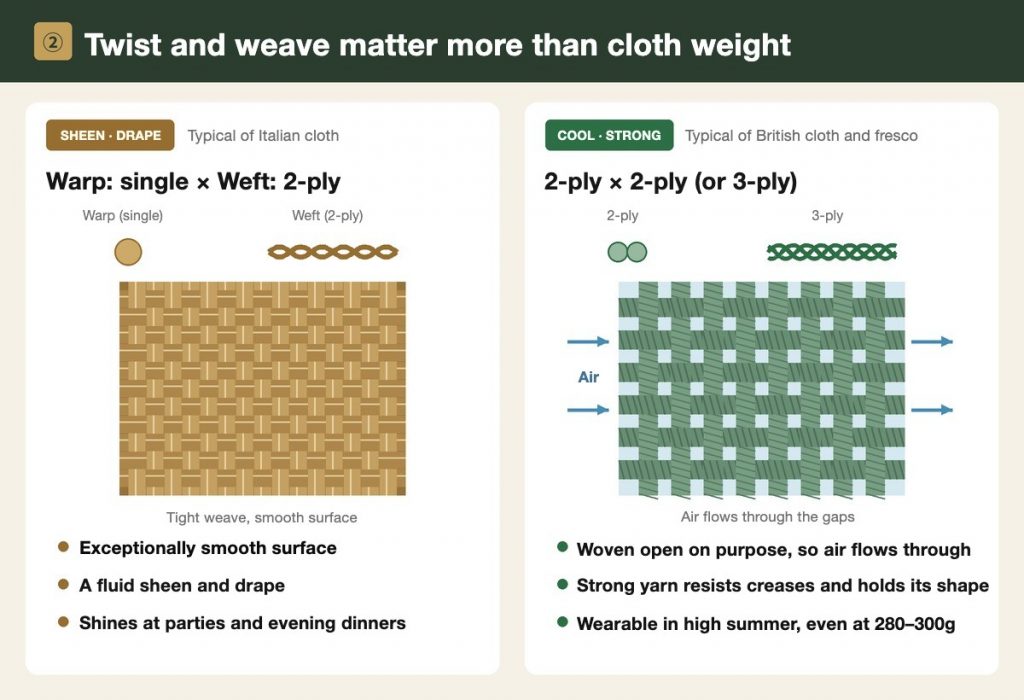
- Single yarn in the warp (lengthwise threads) × 2-ply in the weft (crosswise threads) Skilful use of single yarn gives the surface a liquid, smooth drape and a seductive lustre the moment light hits it. It’s a speciality of Italy’s top mills, and it looks magnificent at parties and evening dinners.
- 2-ply × 2-ply, or 3-ply Two or three yarns are twisted tightly together into one tough thread, which is then used generously in the weave. Because the yarn is thicker, the weight climbs to nearly 280–300g, but by deliberately leaving gaps and weaving it open, you get outstanding breathability, with the wind blowing through so freely you can almost see through the cloth.
You might worry that an open weave will lose its shape, but it’s quite the opposite. Because strong yarns are twisted firmly together in the first place, its durability and recovery are in a different league. It keeps a crisp, commanding silhouette.
Dismissing a cloth with “it’s heavy, so I can’t wear it in summer” just by looking at the weight figure is a real waste. Once you understand how the yarn is built, you can wear a genuine suit that feels substantial yet cool, even in high summer.
Why a Full Lining Is the Safe Choice for Year-Round Wear
Another thing many people hesitate over when ordering is the lining.
- Half-lined: the back lining is left out, prioritising breathability and lightness
- Fully lined: the whole back is lined, prioritising durability and a substantial feel
Certainly, if you only think about the blazing midsummer sun, half-lined is cooler, no question. But if you’re having a suit made as “the one I wear in front of people, whatever the season”, I recommend a full lining without hesitation.
The reason is this: make a year-round cloth up half-lined, and when you wear it to a winter meeting or ceremony, the back looks thin and see-through, and people around you get a chilly impression, as if you’d turned up in a summer suit in midwinter.
For a grown man whose role is to stand before others and give them a sense of reassurance and trust, letting your appearance look cold is not smart. A full lining, with proper cloth quietly hidden across the back, promises a solid, consistent look from behind all year round.
Incidentally, you’ll sometimes hear that cupro, the byword for luxury linings, is “dramatically cooler than polyester”. Speaking from my own experience making clothes on the shop floor, there isn’t that extreme a difference in breathability. Cupro is a plant-based fibre made from cotton, and its real essence is the soft, smooth feel against the skin the moment you slip your arm in. A grown man chooses it not as “a magic cooling trick” but as “a luxury of comfort”.
Why I Wear a Waistcoat Even in Summer, Fully Expecting to Take the Jacket Off
First, picture the occasions when a man of standing actually wears a suit in midsummer. He isn’t walking for miles under the blazing sun. He drives his own car, and the hotel or formal venue he arrives at is, without exception, air-conditioned.
Take the jacket off while you travel and slip it on only when you walk into the venue. Do that, and even a fully lined suit causes you no trouble at all.
And now for the part I care about most: a grown man’s pride.
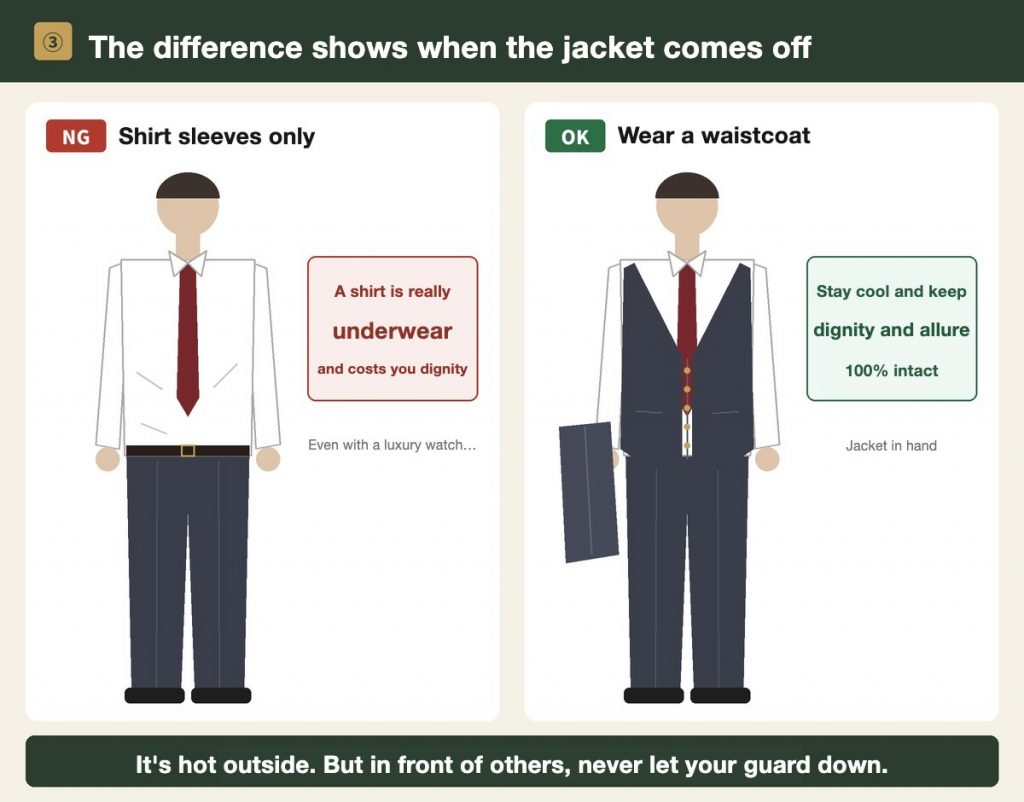
At summer weddings and receptions, I see men who have taken their jackets off because it’s hot and are wandering about in just their shirts. If you’ll forgive me for being blunt, under the rules of classic dress, a shirt is by rights underwear. However expensive the watch on your wrist, standing about in public in just a shirt somehow looks lacking in dignity.
That’s exactly why I suggest having it made as a three-piece, with a waistcoat, on the assumption from the start that the jacket will come off.
Of course it’s hot outside. There’s no need to tough it out and end up with heatstroke. Take the jacket off in the car or on the move. But if you’re wearing a matching waistcoat underneath, you can toss the jacket aside and never be down to your underwear, keeping your crisp dignity and masculine allure 100% intact.
“It’s hot outside. But when I stand in front of others, I never let my guard down.”
Holding to that aesthetic, and being sensible about where to draw the line, is what suit style looks like for a grown man who knows the real thing.
In Conclusion: Go Beyond “Making Do” and Get a Suit That’s Your Signboard
- In Japan’s climate, a “do-everything suit” that’s perfectly comfortable 365 days a year doesn’t exist
- Don’t be swayed by the weight figure: judge breathability and how well it tailors by the yarn twist and the density of the weave
- For a suit you’ll wear in front of others, choose a full lining for substance that never looks chilly in winter
- In summer above all, make a three-piece waistcoat your weapon, so you keep your formality even with the jacket off
Once you’re past the stage of buying suit after suit as consumables, what you should get next is “a suit that’s your own signboard, one you’ll never be embarrassed to wear anywhere”.
“I want a three-piece I can wear with my head held high at important meetings and ceremonies.” “I want advice on a suit that truly suits my lifestyle, not the industry’s sales pitch.”
Whenever you feel that way, you’re always welcome at L’ECRIN in Sasa, Nagasaki. In a calm, appointment-only space, I’ll tailor the finest suit for your presence and position.
Continued
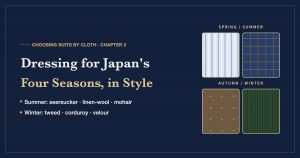
Dressing for Japan’s Four Seasons: From Seersucker to Tweed, the Pleasure of Choosing Suits by Cloth
A suit made to your measurements
Sleeves, trouser hem, jacket length, shoulders and arms are all cut to your own body, not a size chart. Fittings are by appointment only. Tell us the dates you are in Japan and we will propose a time.