Years ago, at a shop where I used to work, a senior colleague drilled a few lessons into me. One of them is still the foundation of everything I do.
“Don’t lean on the brand name above the door. Become someone people want to buy from because it’s you. So watch your customers closely, and hand them jeans that fit perfectly first time, without ever asking their size.”
At the time I thought, “That’s impossible…” But after looking at thousands of bodies since, I understand exactly what he meant. A professional’s job isn’t just reading numbers off a tape measure. It’s working out, through conversation and observation, the habits of someone’s body and the way they like their clothes to feel.
Of all the suits I make, the ones I find most fascinating, and also the hardest, are for men who train seriously at the gym.
A tight waist, a powerful chest and a thick, broad back. Take the shirt off and it’s the kind of V-shaped physique anyone would envy. But seen through a tailor’s eyes, men who lift weights tend to fall into the same trap.
Here it is.
“The more you train your shoulders, the more sloping they actually become.”
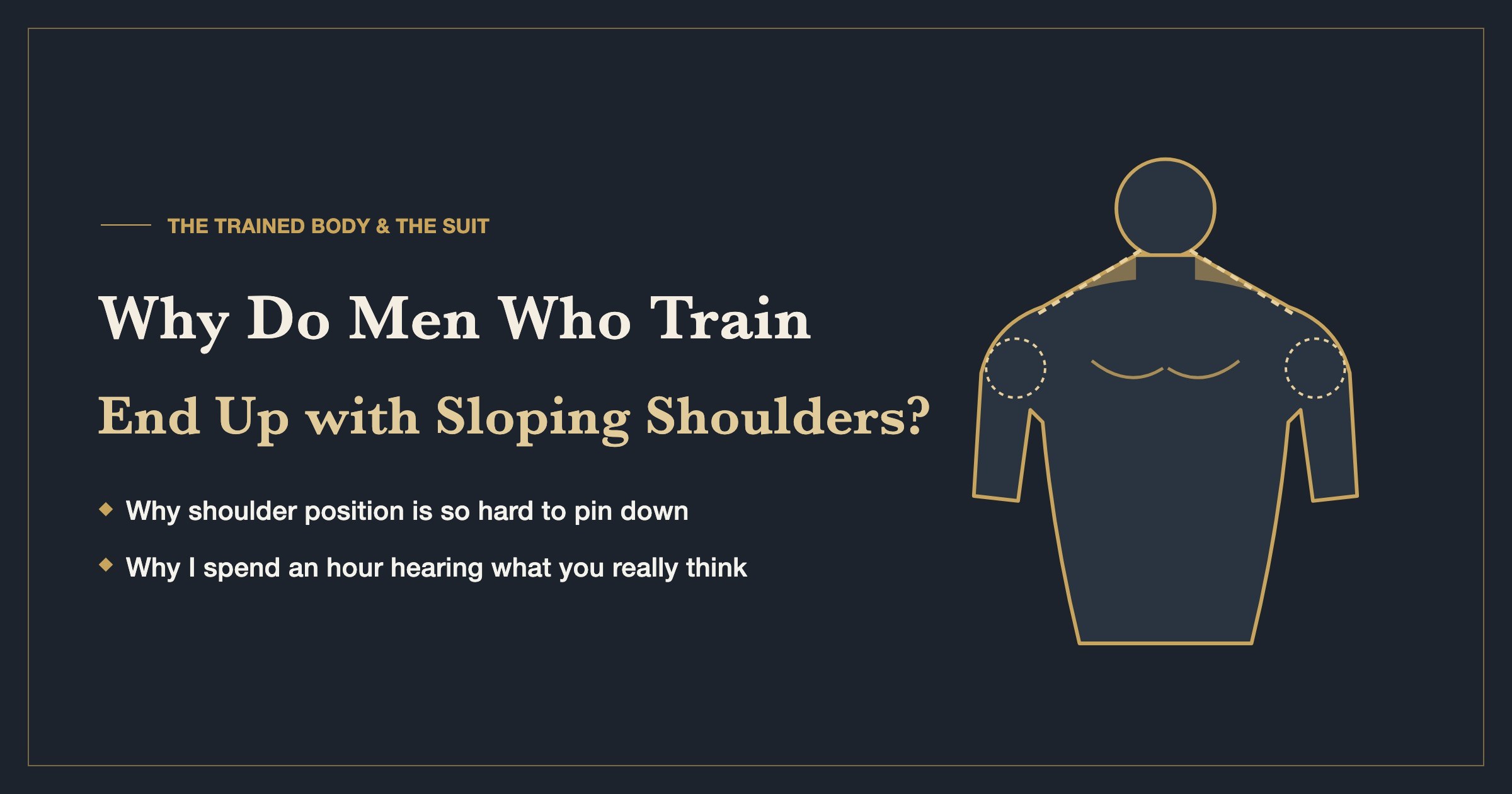
Why Do Men Who Train End Up with Sloping Shoulders?
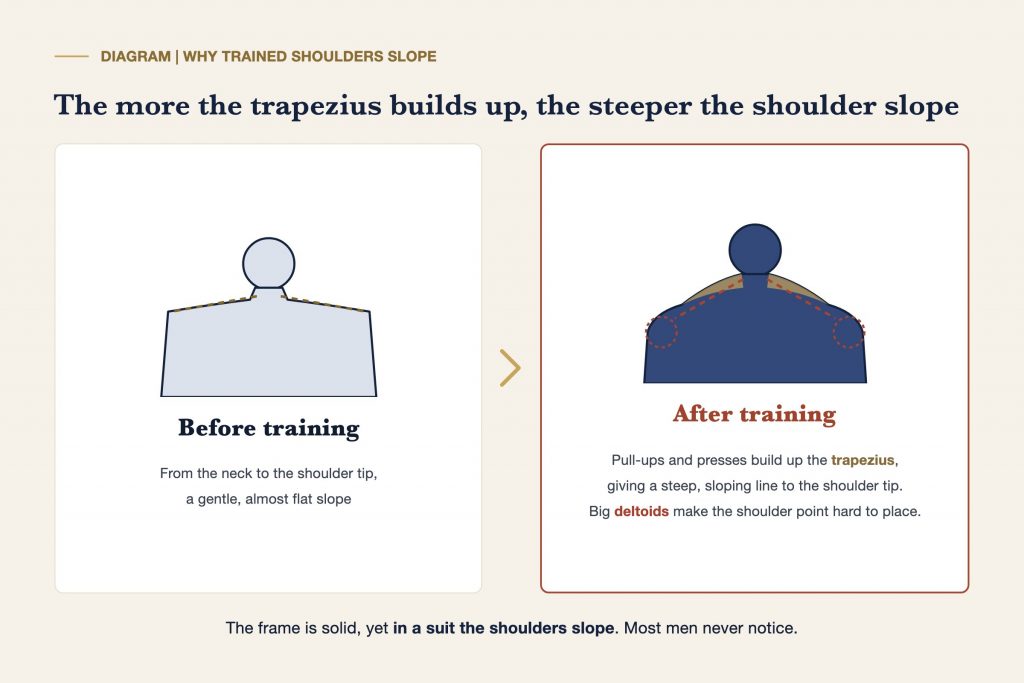
Surprisingly often, the man himself hasn’t noticed. Put in the hours on pull-ups and pressing movements, and the trapezius, the muscle running down the side of your neck, really builds up. The line from the base of the neck to the shoulder tip gets steeper, and although the frame underneath is solid, the moment you put clothes on, it reads as a textbook sloping shoulder.
And the hardest thing with this build is that the shoulder position won’t settle.
When the shoulder muscle (the deltoid) is very large, the jacket’s armhole gets dragged at an angle by the sheer bulk of muscle, and it inevitably feels cramped.
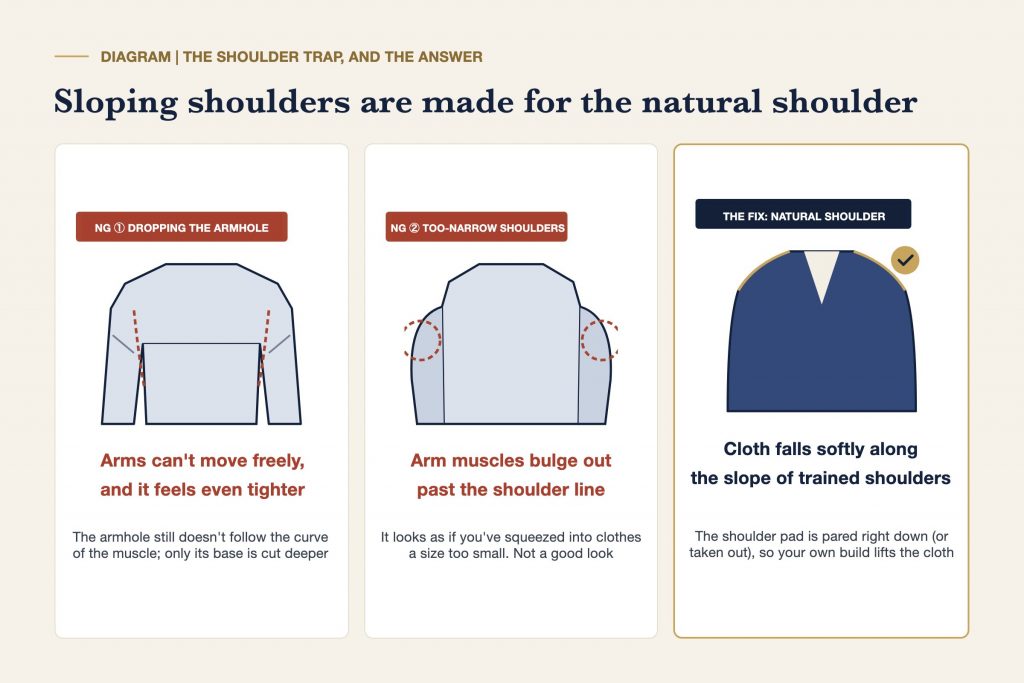
The usual fix is to lower the underarm, the bottom of the armhole. But if the shape of the armhole itself doesn’t match the curve of the muscle, simply digging the bottom deeper only makes the arms harder to move, and the jacket ends up even less comfortable.
On the other hand, if you push the shoulder width right to the limit because you want a clean, sharp look, the big arms (biceps and triceps) have nowhere to go, and when you put the jacket on, the arm muscles bulge out beyond the shoulder line.
Once the arms sit wider than the shoulders, it somehow looks as if you’ve forced yourself into clothes that are too small, and it isn’t a good look. Chase a sharp silhouette and your body cries out; give it too much room and you end up looking like a drainpipe. That tug-of-war is what makes it so genuinely difficult.
Turning It Around: Sloping Shoulders Look Best in an Italian-Style Natural Shoulder
That said, there’s absolutely no need to feel down about having sloping shoulders. In fact, this is what I always tell people.
“The more your training has given you sloping shoulders, the better a ‘natural shoulder’, with no padding or only the thinnest layer, is going to look on you!”
With a British-style suit, where the shoulders are built up firmly with square pads, the pads on a sloping-shouldered man tend to stick out at the corners and look unnatural. But switch to a soft, Italian-style shoulder (the kind made in Naples, for example), with the padding pared right down or taken out altogether, and the supple cloth drapes gently along the slope of the shoulders you’ve worked so hard on.
“It isn’t padding in the jacket shaping the shoulders. It’s the sheer depth of the body you’ve built that’s lifting the cloth.”
That gives you a wonderful kind of allure and ease that only someone who trains can carry off. The sloping shoulders you thought of as a weakness become your greatest asset in classic Italian tailoring.
Nobody Tells You the Truth at First. That’s Why I Talk for an Hour
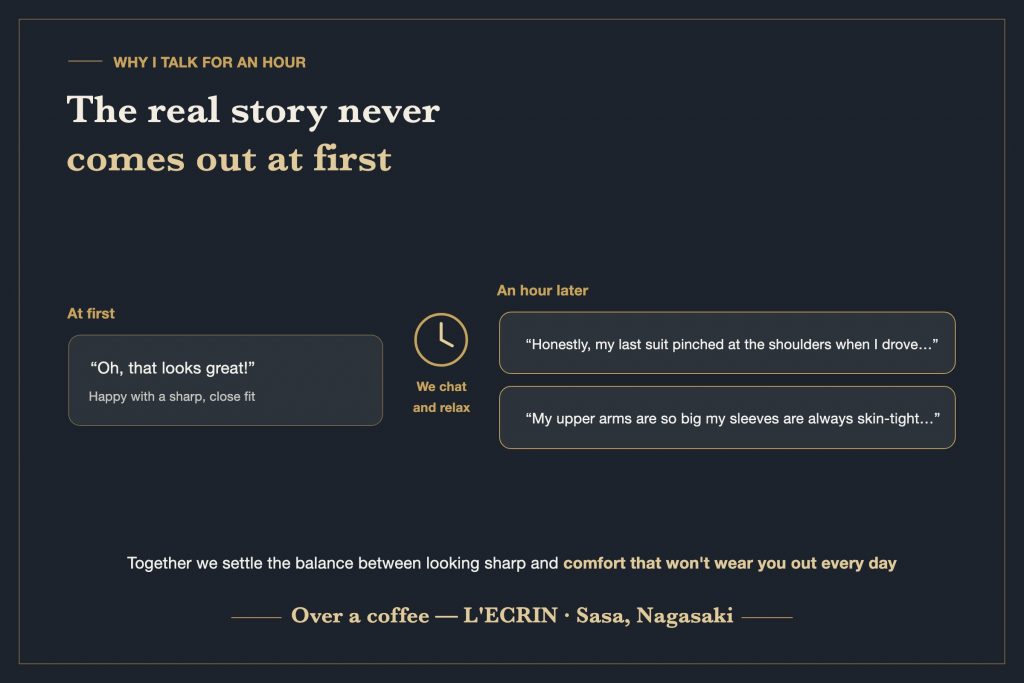
When I make a suit, I first have the customer try on the version that looks sharpest, the closest fit. They look in the mirror and say, “Oh, that’s great!”
But of course a close fit looks good. Make the suit on that basis alone, and the moment you actually drive in it or wear it through a full working day, it’s bound to feel tight and wear you out.
That’s exactly why the most important thing is to talk it through properly with the customer and agree on the balance between looking sharp and a fit that won’t tire you out in everyday life.
The thing is… nobody ever tells you what they really think at first (laughs).
You can’t walk into a shop for the first time and immediately say, “Actually, this bit is tight…”, can you? Everyone is a bit nervous to begin with. In my experience, it’s only after we’ve chatted, relaxed with each other, and about an hour has gone by that the real story finally slips out.
“To be honest, the suit I had made before was so tight in the shoulders and under the arms when I drove that it was a pain to wear.” “My upper arms are so big that my sleeves are always skin-tight, and it’s embarrassing…”
Only once I’ve heard that can I make a suit that’s genuinely easy for that person to wear, and one they’ll love for years. “Make them want to buy from you, not from the brand name.” Looking back now, I think that old lesson was about exactly this kind of conversation.
Even Walking Down the Street, All I See Is People’s Frames
I may sound full of myself here, but there are countless people out there who tailor better than I do, and truly remarkable craftsmen. That’s exactly why there’s no finish line, and I’m still learning every single day.
It’s a complete occupational hazard, but even walking around town on my day off, I catch myself thinking, “Ah, he trains, so those are properly sloping shoulders,” or “With a walk like that, balancing the arms and the shoulder width would be tricky,” my eyes following everyone’s quirks without my even meaning to (laughs).
If you lift weights and find your suits feel tight, or if a poor fit around the shoulders and arms leaves you worn out, let’s start by sitting down over a coffee and talking for an hour. There’s no need to be nervous. Just tell me, honestly, what’s bothering you about your body and your clothes.
Related reading
Why I Honestly Think Tailors Should Train Like Osteopaths: Guessing Jeans Sizes, and the Round Back with a Pigeon Chest
Tailoring a Suit for a Former Bodybuilder with 65 cm Arms: The Customer Every Shop Had Turned Away
Why Your Jacket Back Lifts Into an “Inverted Triangle”: What Tailoring for a Boat Racer and a Pitcher Taught Me
A suit made to your measurements
Sleeves, trouser hem, jacket length, shoulders and arms are all cut to your own body, not a size chart. Fittings are by appointment only. Tell us the dates you are in Japan and we will propose a time.