Men who train their upper body often complain that off-the-rack jackets won’t go on. In the same way, men with a lot of muscle in their legs almost always hit a wall when it comes to buying trousers.
If you played baseball or football at school, or you push your legs hard with squats, you’ve probably been through something like this:
- Buy for your thighs, and the waist is so loose you can fit several fists inside
- Buy for your waist, and the trousers catch on your thighs and seat and won’t pull up
- Force the belt closed, and the cloth bunches up around the waist and looks a mess
I’ve been making made-to-measure suits in Sasa, Nagasaki for 13 years. Of everyone I’ve measured, the lower body that astonished me most belonged to a customer who races keirin professionally. (Keirin is Japan’s professional track-cycling sport, where riders sprint on fixed-gear bikes around a banked oval.)
Using the actual measurements I took that day, I’ll explain why men with a powerful lower body can never look sharp in off-the-rack trousers, and how a tailor solves the problem.
Slim in everyday clothes, but off the charts once the tape came out
When he walked into the shop, my first impression was of a lean, trim build. Through his clothes, nothing looked especially big.
But once I started measuring him for trousers, I had to look at the tape twice.
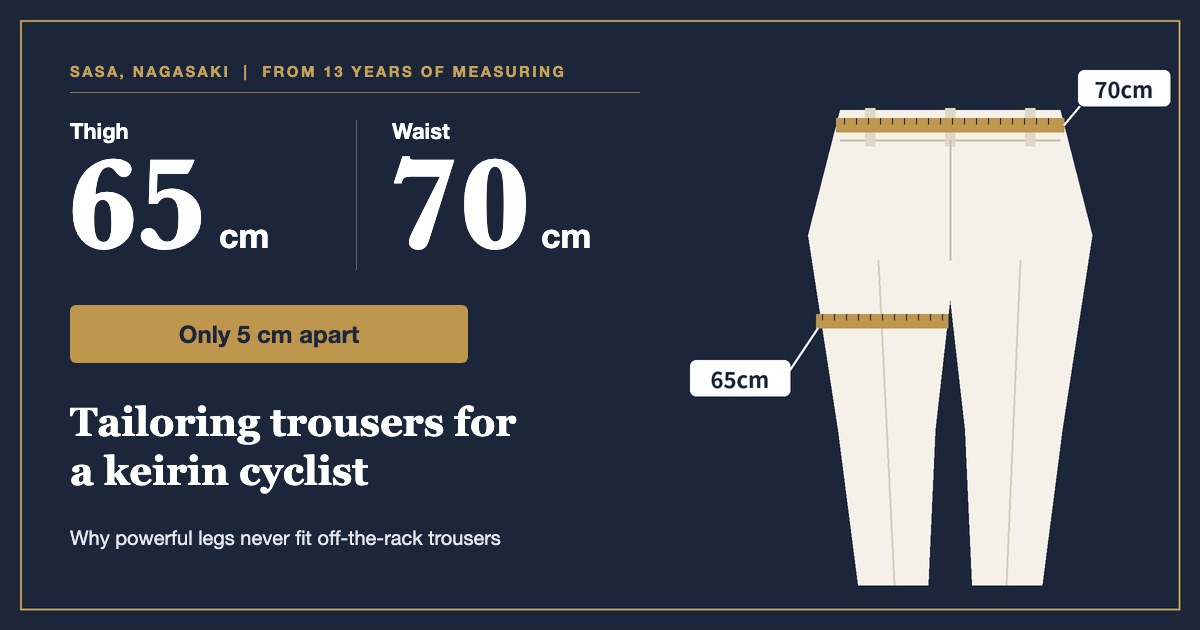
- Thigh (watari): 65 cm (about 25.5 inches)
- Hip: 105 cm (about 41 inches)
- Waist: 70 cm (about 27.5 inches)
A 65 cm thigh on a grown man is something you rarely see, even among serious athletes. (This number also shows just how extraordinary the 65 cm arms of the former bodybuilder in my previous article were. His arms were the same size as these thighs.)
His waist was trimmed right down to 70 cm, while his thighs measured 65 cm. The difference between his waist and one thigh was only 5 cm (about 2 inches), a balance no ready-made size chart could ever cover.
I’ve made clothes for many baseball and football players, and when their thighs are big, their waist and calves tend to be big too. The keirin rider was different. Only his thighs and seat were hugely developed. His calves were ordinary, and his waist was tight and narrow.
It’s an unusual build even among athletes, and the moment I saw those numbers I knew there was no way off-the-rack trousers would ever work for him.
How a tailor handles it: simply letting the seat out leaves slack fabric under it
There’s another big reason men with a powerful lower body can’t wear ready-made trousers: a prominent seat.
Keirin riders drive the pedals hard every day, so their gluteal muscles are developed to the limit. The fullest point of the seat sits high and sticks out sharply behind them.
When you make trousers for this build, there’s one trap a tailor must never fall into: thinking “his seat is big, so I’ll just make the hip measurement bigger all round.”
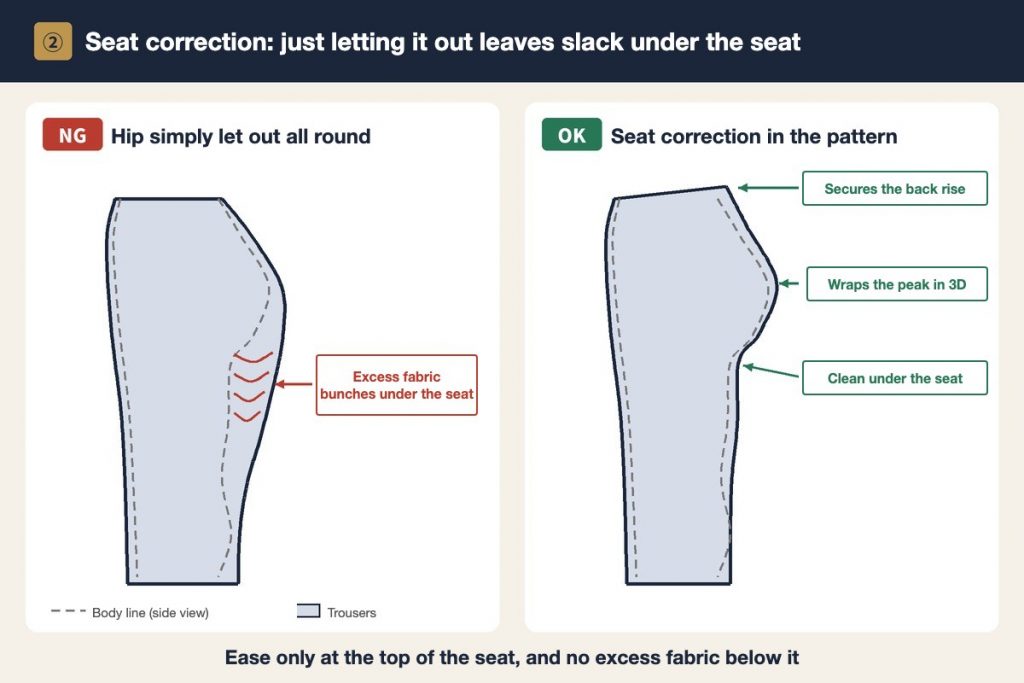
If you only enlarge the hip measurement to add room, the trousers will certainly go over the seat. But with too much ease, surplus fabric bunches up untidily just under the seat, around the top of the back of the thighs.
So this is how I designed his trousers.
1. Seat correction, taken as far as it would go
Because the fullest point of his seat was high and pushed well back, I put the maximum possible prominent-seat correction into the pattern. That secures enough back rise while creating a three-dimensional curve that wraps around the peak of the seat.
2. Cutting away the slack under the seat
With the seat correction in place, I could leave the necessary ease at the top of the seat while pushing for a clean line right at the limit, with no extra fabric sagging underneath.
3. A taper that makes the most of his ordinary calves
If you cut the legs wide all the way down to match a 65 cm thigh, you end up with shapeless “drainpipe” trousers. His calves were lean, so I narrowed the leg naturally from the knee to the hem, giving a sharp silhouette that doesn’t draw attention to the size of his thighs.
A common misunderstanding: “I had the thighs slimmed, and now I can hardly wear them”
One of the requests I hear most often when making or altering trousers is this: “The seat is fine, but the thighs feel baggy, so please take them in.”
And when the thigh width is taken in just as asked, almost everyone comes back saying the same thing: “They’re really hard to wear now” or “They’re unbearably tight when I sit down.”
Why does this happen? The reason is very simple. Where the customer thinks the “thigh” is and where the thigh sits in the construction of a pair of trousers are completely different places.
On a pair of trousers, the “thigh” starts just below the seat
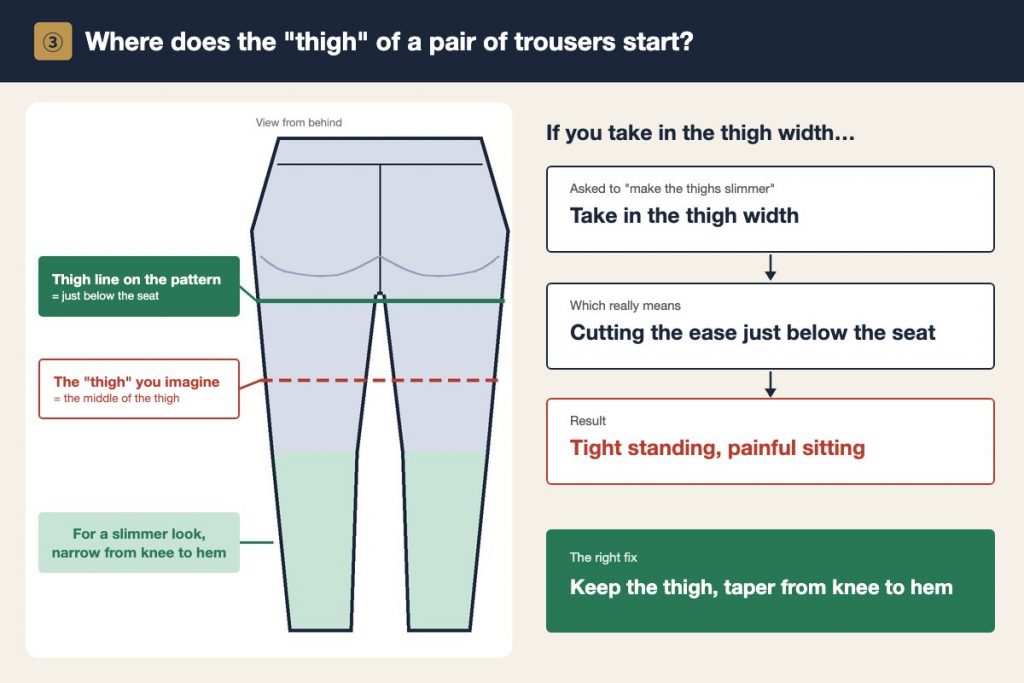
When most people hear “thigh measurement,” they picture the middle of the thigh. On a trouser pattern, however, the thigh line (the watari) starts right below the seat, at the point Japanese tailors call the shitajiri.
That means taking in the thigh width is exactly the same thing as cutting away the ease just below the seat. Remove that, and the area under your seat pulls tight even when you’re standing still. The moment you sit down, the cloth has nowhere to go and your thighs and seat are squeezed hard.
To be honest, for all my lecturing, I’ve made this very mistake with my own trousers more than once. “Just a little slimmer so they look sharper…” I’d take in the thighs, then regret it the first time I sat down. I’ve learned the hard way, which is why I can tell you with confidence: never do this.
For a slimmer look, narrow from the knee to the hem, not the thigh
“So does that mean men with big thighs have to give up on a slim look?” Not at all. The solution is very simple.
Keep all the ease the thighs (and the area under the seat) need, and narrow the leg from the knee down to the hem: a taper.
Trousers are already built to narrow towards the hem. What people’s eyes actually follow isn’t the top of the thigh but the line of the ankle and lower leg. Just tapering below the knee by the right amount gives you a silhouette that looks surprisingly long-legged, slim and sharp, with no strain at all on the thighs or seat.
“I want them fairly slim”: the request, and what goes into choosing the cloth
This customer was clear about what he wanted: “Just because my legs are big doesn’t mean I want baggy trousers. I want them fairly slim and sharp.”
So I suggested a cloth with good stretch, a blend containing polyurethane and polyester.
Because it stretches with the movement of the muscles, he could move freely even in a slim cut.
But there’s something I always have to tell customers at this point, as a matter of professional responsibility: I have to be open about the drawbacks, not just the benefits.
This is what I told him, honestly:
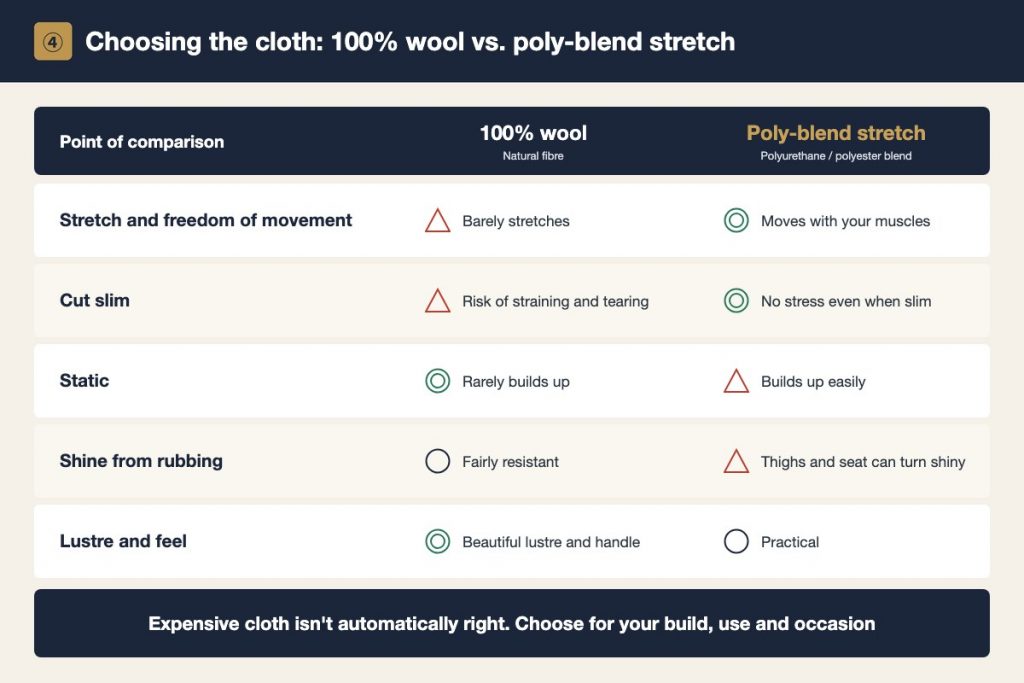
“With stretch in the cloth, I can give you the slim silhouette you want. But because it contains synthetic fibres like polyester, it builds up static more easily than natural 100% wool. It also has another weakness: over long wear, the areas where your thighs and seat rub together tend to turn shiny.“
Once he fully understood all of this, he chose the cloth that would give him the least stress.
The bottom line: expensive cloth isn’t automatically right. The best cloth suits where and how you wear it
There’s a common belief that imported luxury wool is the ultimate. And it’s true that the finest Italian and British cloths have a wonderful lustre and feel.
But “more expensive cloth isn’t always better” is one of the subtleties of suits.
Even a luxury wool costing hundreds of thousands of yen carries a high risk of straining and tearing if it’s cut tight for an athlete whose muscles are constantly working. For businessmen who are on the move all day, or for athletes, the right answer is often not the most luxurious cloth but one that combines durability with stretch.
What matters most isn’t the brand name or the price of the cloth. It’s whether it suits your build, the situations you wear it in, and the occasion.
If you’ve given up on trousers because of big thighs or a full seat, or you want a slim, sharp pair but worry that off-the-rack ones would tear, please come and talk to me.
I’ll make you a pair that fits your body as it really is, and the life you really wear them in.
A suit made to your measurements
Sleeves, trouser hem, jacket length, shoulders and arms are all cut to your own body, not a size chart. Fittings are by appointment only. Tell us the dates you are in Japan and we will propose a time.