When most people put on a suit and check themselves in the mirror, they only look at the front. The chest, the line around the stomach, the sleeve length. If the front looks clean, it’s easy to think, “Right, the size is fine,” and leave it there.
But when I walk around town or see people at work, there’s one place my eyes always go.
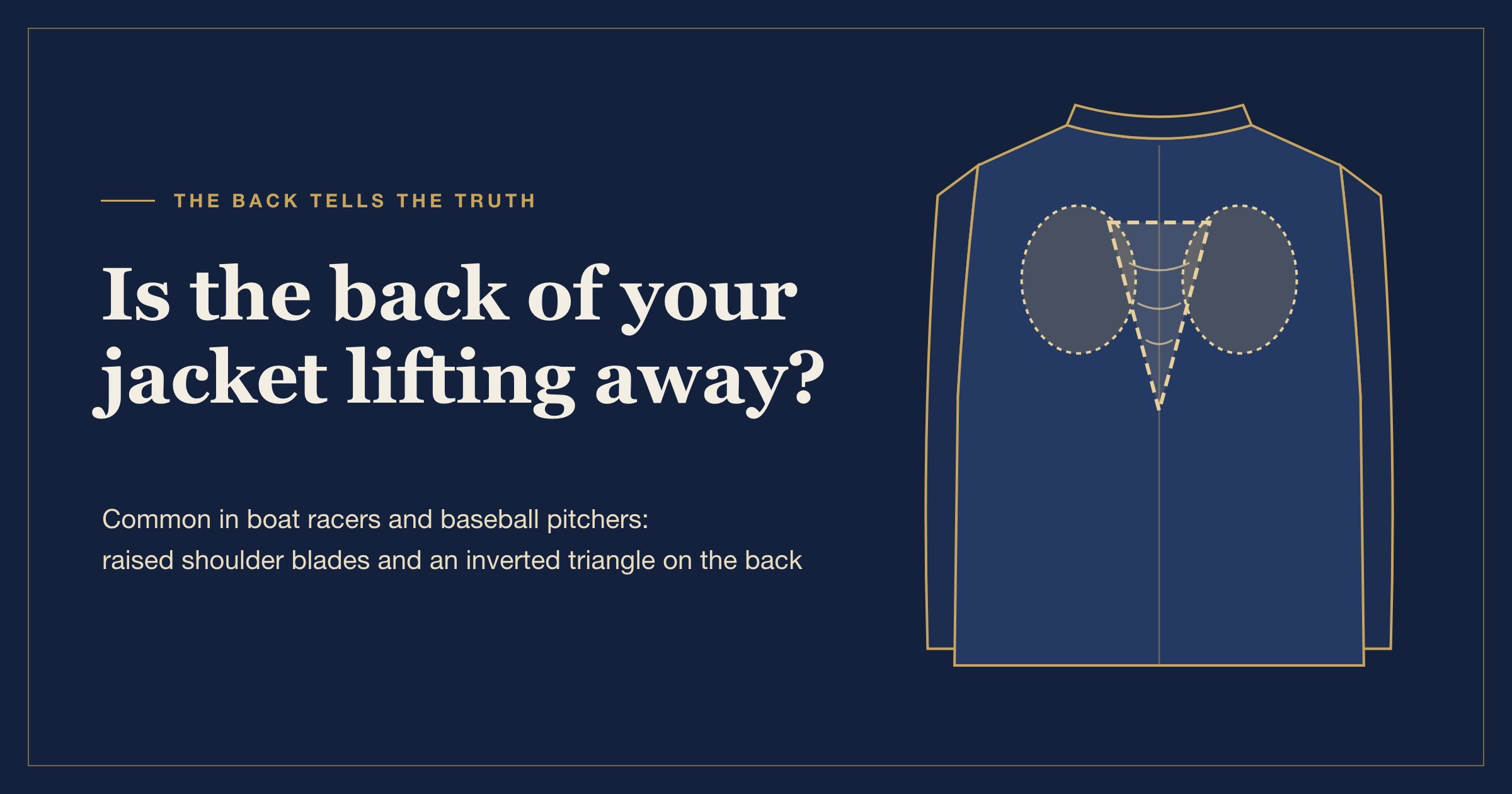
It’s the man who looks slim and sharp from the front, but from behind, the back of his jacket (between the shoulder blades) has lifted away from his body, leaving an awkward, inverted triangle of slack fabric.
The wearer can’t see his own back, so he has no idea. But to anyone passing by or sitting behind him, there’s clearly extra fabric bunching up back there. Every time I see it, I think, “Oh, I want to fix that for him…!” That’s a tailor’s occupational hazard, pure and simple (laughs).
Of course, creases and slack on the back of a suit can come from many things tangled together: rounded shoulders, a swayback, a stoop, high square shoulders and more. You can’t point to one thing and say, “This is always the cause.” Every build is different, and so is every set of creases.
Still, out of the thousands of bodies I’ve seen in 13 years as a tailor, the one that left the strongest impression by far was the back of a customer who was a professional boat racer.
The first-glance trap: “He’s slim, so a small size will do”
In Japan, boat racing (kyotei) is a professional sport in which racers pilot small hydroplanes around a short water course. The racers are pro athletes who have to keep making a strict, demanding weight limit (for men, around the low 50 kg range, roughly 110–120 lb).
At first glance, he looked very lean and slim. “With a build like this, a standard size, or maybe even a slightly smaller slim fit, will sit nicely,” I thought at first.
But the moment I picked up the tape measure, that assumption was turned completely on its head.
The tape won’t lie flat on the back, and you know right away
You can tell the instant the tape touches the back.
On a typical build, when I measure the back width, the tape settles smoothly against the shirt as if it were drawn to it. With this customer, though, the tape wouldn’t follow the back at all. It stretched tight between the peaks of his left and right shoulder blades and floated in the air between them.
“His back isn’t flat. His shoulder blades stick out like two little hills.” I could feel it clearly through my fingertips and the tape alone.
And when he put on a try-on jacket, sure enough, the fabric was pulled hard toward each shoulder blade, and the space between them lifted away into that awkward inverted triangle of slack.
Creases and slack on the back have many causes depending on build and posture, but this “inverted triangle caused by protruding shoulder blades” is something I see often in athletes who have used their hands and arms hard.
What boat racers and baseball pitchers have in common
So why does the back alone lift away on someone so slim?
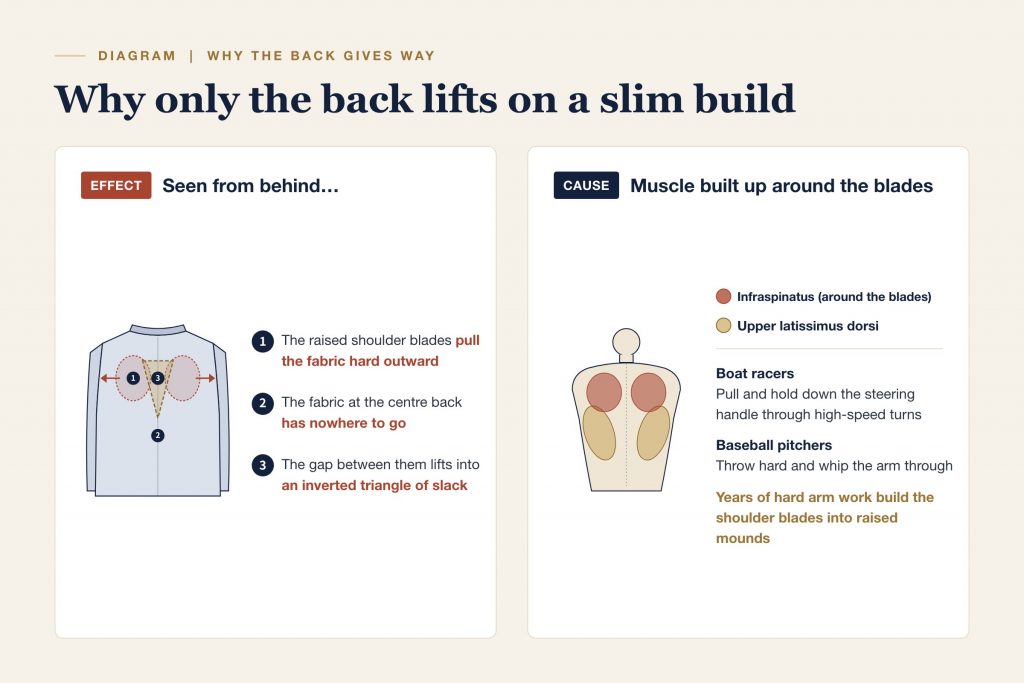
In the turns, boat racers keep wrenching the steering handle and throttle lever while fighting fierce centrifugal force and the impact of the water. My own view is that, as a result, only the muscles around the shoulder blades that pull the arms back hard and hold them down (the infraspinatus and the upper part of the latissimus dorsi) become extraordinarily developed.
And exactly the same is true of baseball pitchers, or anyone who pitched seriously in the past.
People who have thrown a ball hard and whipped their arm through tens of thousands of times build up powerful, raised muscle around the shoulder blades. When I put my hand on someone’s back while measuring and feel that firm bump, I think to myself, “Ah, this person has seriously played a sport that pushes the hands and arms to the limit.”
Off-the-rack suits only allow for a flat back
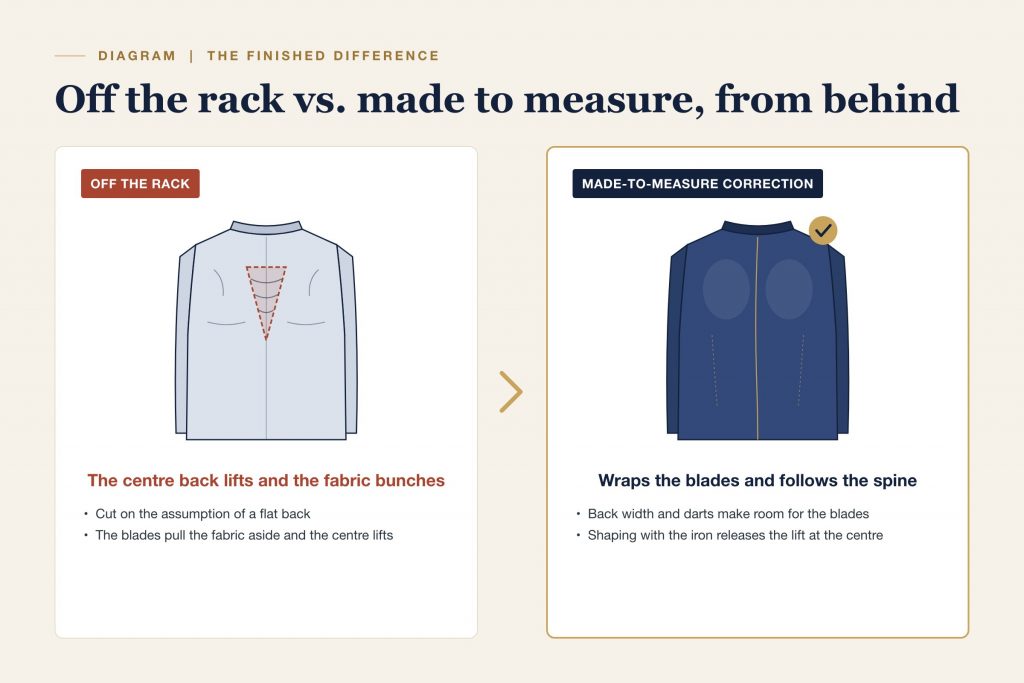
A typical off-the-rack suit jacket is cut flat, to fit the average Japanese back, which is gently sloped with little up-and-down shape.
So when someone with protruding shoulder blades wears one, the following is bound to happen.
- The fabric is pulled hard toward the protruding left and right shoulder blades
- Pulled out to both sides, the fabric along the centre line of the back has nowhere to go, so it lifts away and leaves an inverted-triangle gap
- When he reaches forward or grabs a strap on the train, the back pulls so tight it feels ready to split
Choose a slim off-the-rack jacket because you’re slim, and the shoulder blades get squeezed until you can’t move your arms. Size up to make room for the shoulder blades, and the body turns baggy and the suit ends up wearing you. With this kind of back, the problem simply can’t be solved off the rack.
Wrapping the shape of the shoulder blades and letting the lift fall away cleanly
To tailor this kind of build well, you need three-dimensional corrections made for it.
- A shaped curve across the back (planning the back width and darts): Rather than forcing the protruding shoulder blades flat under flat fabric, I create room that wraps around those peaks in three dimensions.
- Corrections that take out the “lift” in the middle (shaping and pressing the cloth with the iron): I release the inverted-triangle slack that gathers in the centre when the fabric is pulled to both sides, so the cloth falls cleanly and follows the line of the spine.
Tailored this way, the jacket fits beautifully with not a single crease across the back when you’re standing, and when you reach forward, the shoulder blades move smoothly without any pull. The result feels as if the jacket is part of you.
The worst part: you can’t see it, and nobody will tell you
What makes this shoulder-blade problem the trickiest of all suit problems is that the wearer can never notice it himself.
When you check the mirror before heading out in the morning, all you see is the front: your chest, your waist, your tie. “Good, slim and sharp,” you think, and you’re satisfied.
And the scariest thing is that the people around you (colleagues, clients, friends) won’t kindly go out of their way to say, “Hey, there’s extra fabric lifting off your back,” even when it looks awkward.
Yet at work, at weddings and at funerals, more than half the time people spend looking at you, they’re seeing you from behind or from an angle behind you.
You think you’re wearing your suit perfectly, but to the people passing by or standing behind you, you look like someone in a suit that doesn’t fit. Nothing could be more of a waste.
Conclusion: if you’ve played a sport that uses your arms, take a second look at your back view
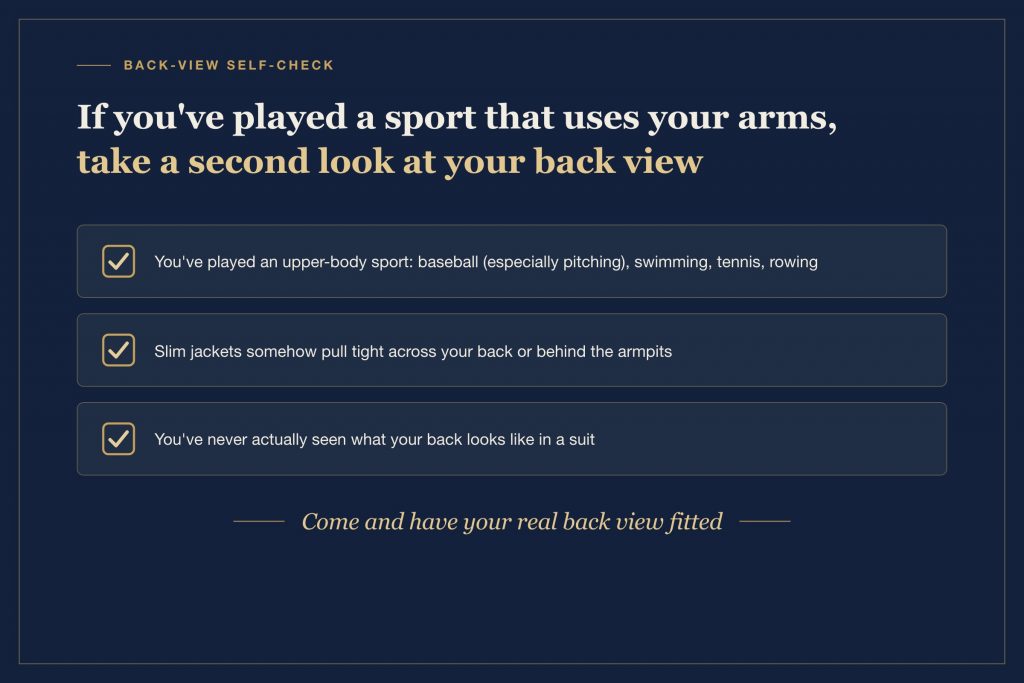
- You’ve played a sport that works the upper body, such as baseball (especially pitching), swimming, tennis or rowing
- Slim jackets somehow pull tight across your back or behind your armpits
- You’ve never actually seen what your own back looks like
The reasons for creases and slack differ from build to build, but if you’ve thrown yourself into a sport that works your hands and arms hard, the real cause of that odd feeling may be the muscle around your shoulder blades.
I’ll tailor a suit that shows off the physique you’ve proudly built through sport, right down to your back view.
Come in and have your real back view fitted.
You might also like
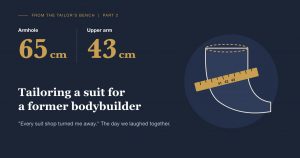
Tailoring a Suit for a Former Bodybuilder with 65 cm Arms: The Customer Every Shop Had Turned Away
Tailoring a Keirin Cyclist’s Trousers: Why 65 cm Thighs and a 70 cm Waist Never Fit Off-the-Rack
A suit made to your measurements
Sleeves, trouser hem, jacket length, shoulders and arms are all cut to your own body, not a size chart. Fittings are by appointment only. Tell us the dates you are in Japan and we will propose a time.