

Once the wedding planning meetings begin, there is a big wall that every bride and groom runs into sooner or later.
Two walls, really: your sense of money going completely haywire, and the planning meetings that seem to go on forever.
At the supermarket you would happily agonise over a difference of ¥100 or ¥1,000. Yet put a wedding venue’s estimate in front of you, and your sense of what things cost goes straight out of the window.
- “Would you like to upgrade the flowers on each table for an extra ¥2,000?” ➔ It’s only ¥2,000, you think, and say yes. With ten tables, that alone is another ¥20,000.
- “Shall we go up a grade on the dinner menu? It’s just ¥500 more per guest.” ➔ It feels like loose change, so you agree. With 100 guests, that alone is another ¥50,000.
So why does your sense of money go numb like this? The reason is simple.
The planning is chopped up into lots of separate meetings, so you can’t keep track of what you decided last time, or how much you have already added.
At first it’s once a month. As the big day gets closer, it becomes once every two weeks, and so on. At each meeting you are asked to sign off on another option worth tens of thousands of yen. You never really feel the running total from the last meeting, the little jabs keep landing, and before you know it the estimate has jumped by several million yen.
“If we just locked ourselves in a room from morning till evening for one day, we could get all of this done in no time!” That’s what I used to think at every single meeting, because I’m someone who once threw a big, flashy wedding for 120 guests myself (laughs).
So I understand better than anyone how couples get worn out by the preparations until their heads stop working properly.
But as a tailor who has worked on both sides, in formalwear hire and in selling suits, there is one thing I always tell my customers.
“Stop and think for a moment! Paying hundreds of thousands of yen for an outfit you’ll wear for a few hours, and settling for the wrong size on top of that, is the biggest waste of all!”
The “From ¥50,000” Trap, and the Reality of New Designs at Over ¥100,000
Flick through a bridal wear catalogue and you will sometimes see “hire from ¥50,000”. But what actually happens when you go to the bridal salon?
What ¥50,000 gets you is mostly outfits made years ago and worn by dozens, if not hundreds, of people before you, with tired designs and tired cloth. The moment you think “since it’s a special day, I’d like something nice” and glance at the newer, more stylish pieces, the price shoots past ¥100,000 without a second thought, and for a groom’s tuxedo it leaps to ¥200,000–300,000.
Hundreds of thousands of yen for clothes you wear only for a few hours during the reception. Everyone’s values are different, so I’m not saying spending money on that is right or wrong.
But as someone who used to work in hire, once you know how the industry works behind the scenes, you can see exactly why it gets so expensive.
Why Is Wedding Hire So Expensive? What Goes On Behind the Scenes
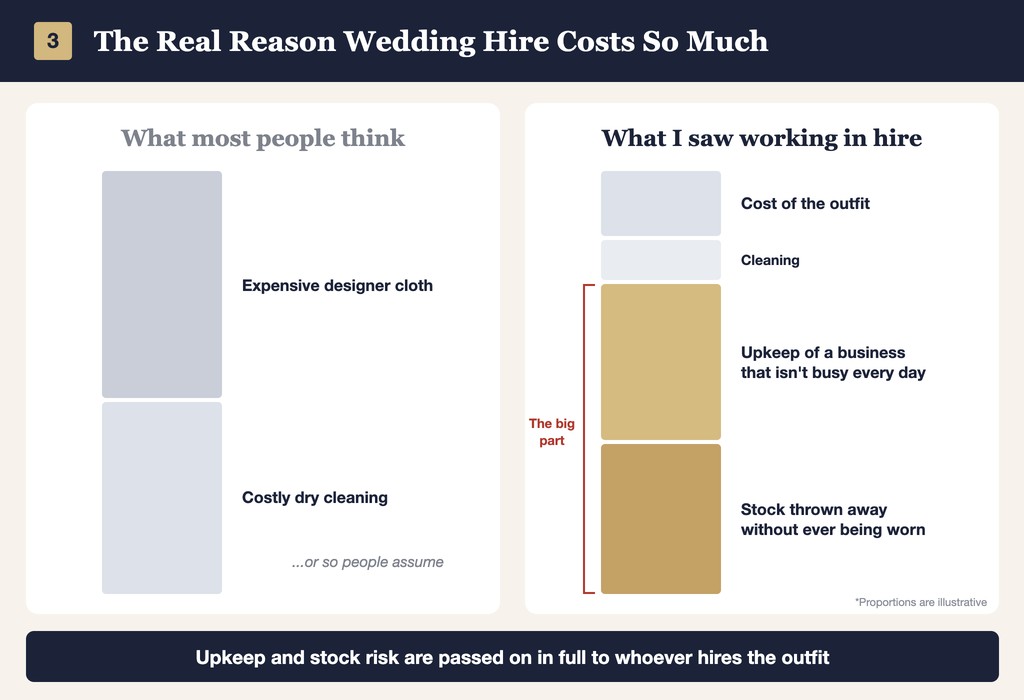
“Because they use expensive designer cloth?” “Because every wear means a very expensive dry-cleaning bill?”
That’s what most people assume, but it isn’t the case.
The cost of buying in the outfits is nowhere near the eye-watering sum most people imagine. As for cleaning, the bridal trade has its own specialist cleaners for formalwear, so it costs far less than most people would think. You would be surprised how cheaply everything is cleaned. (Traditional Japanese silk kimono are another matter and genuinely expensive, but this is especially true of Western wear such as tuxedos.)
So why is hire so expensive? The answer is simple: there isn’t a wedding every day.
It’s not a business like a pub, with customers coming through the door every night. Of all the outfits a shop buys in, some miss the trend or never fit anyone, so they sit in the stockroom without ever being hired and are eventually thrown away. That is perfectly normal.
In other words, the high hire price is less about the value of the outfit itself and more that the upkeep of a business that isn’t busy every day, plus the loss on outfits thrown away without ever being worn (the stock risk), are passed on in full to whoever hires them.
The Most Unfair Part: Paying a Fortune and Still Settling for the Wrong Size
Back when I was in the hire business, there was one thing I thought to myself, over and over and over again.
“They’re paying this much, and I still have to ask them to settle for a size that doesn’t quite fit? That’s just wrong. They’d be so much better off buying a suit…”
Hire outfits are already made in fixed sizes such as S, M and L. Broad shoulders, long arms, a pigeon chest or a rounded back, powerful thighs… Every body is different, yet all you can do is squeeze yours into one of the sizes on the rail.
And the result? “Fit the shoulders and the waist is baggy.” “The trouser length is right, but they’re tight across the seat.” You’re paying tens of thousands, often well over ¥100,000, sometimes more than ¥200,000, and yet the groom ends up shrugging and settling for it: “Well, it’s hire, so it was never going to fit perfectly.”
You’re the one in the spotlight, on a day when hundreds of photographs will be taken and kept for the rest of your life. Why should you pay a fortune and still settle for the wrong size?
Fathers Hire for Around ¥50,000, While Grooms Mix and Match Wisely
If you think calmly about what each outfit will actually be used for, the smart choice becomes very clear.

- The father’s morning coat: It is the most formal daytime dress there is, but the cut is so particular that there is almost no chance to wear it again once the wedding is over. If you ask at the venue or a formalwear shop, you can usually hire one for around ¥50,000. Since it’s something he will hardly ever wear, simply hiring one is the most economical and sensible choice for the father.
- The groom’s tuxedo or suit: Some of the grooms who come to my shop do, of course, have a proper tuxedo made. But more and more of them now want to walk into their wedding in a really stylish made-to-measure suit, the one they truly want to wear.
Why? Because at many venues, the basic package already includes one tuxedo and one dress.
So the smart grooms split it like this.
- The ceremony (in the chapel): Wear the hire tuxedo included in the package, and make your vows looking sharp in a classic, dignified atmosphere.
- The reception and the after-party: At the costume change (a Japanese reception tradition where the couple slip out and return in a new outfit), make your entrance in a stylish made-to-measure suit, tailored to your body and the one you really wanted to wear!
That way you make full use of the hire allowance in the venue’s package, and best of all, you can wear your own suit not just at the reception, but straight on to the after-party. With hire wear you are often told that taking it to the after-party costs extra, but your own suit can go wherever you like.
And once the wedding is over, you can keep wearing it for years as a superb suit for life: at friends’ weddings, anniversary dinners and the big moments at work. For today’s groom, I think this is the smartest and most satisfying way to choose what to wear.
It’s a Hassle, but You Really Should Have a Wedding!
I’ve been very frank about what goes on behind the preparations and about money, but there is one thing I want to say from the bottom of my heart before I finish.
“Getting to the wedding is an enormous hassle, but you absolutely should have one!”
There are endless meetings, there’s homework, the sums give you a headache, and there may be times you nearly fall out with your partner. But then the day arrives, the doors open, and there is the scene spread out in front of you.
A moment when this many people who matter to you gather just for you, smiling and applauding: you will never have that again in your life.
That overwhelming happiness and gratitude is worth far more than all the effort of the preparations, however hard they were. Honestly, if it weren’t for the planning, I’d happily do the whole wedding all over again (laughs).
That is exactly why I don’t want you to lose your sense of money halfway through the preparations and let it pour away, or to end up with regrets about an outfit that didn’t fit.
Next in the series
How Venue ‘Bring-In Fees’ Really Work: A Former Partner Shop on Referral Commissions, and the Groom’s Ultimate Move Before You Sign
Related reading
Why a Loud Suit Gets Hard to Wear at 24: What Happens to Your Coming-of-Age Suit, and the Reversal That Comes with Your Second
Tuxedos we have tailored at L’ECRIN
A suit made to your measurements
Sleeves, trouser hem, jacket length, shoulders and arms are all cut to your own body, not a size chart. Fittings are by appointment only. Tell us the dates you are in Japan and we will propose a time.