Open any book on suits and you’ll find the “correct” sleeve length spelled out something like this: “With the arms hanging naturally, the sleeve should just cover the wrist bone, showing about 1–1.5 cm of shirt cuff. That is the most elegant length.”
But after years on the shop floor as a tailor, I keep running into moments where the only way to get a suit to a perfect score is to deliberately break that textbook rule.
The best example I can give you is a black suit I once made for a customer who plays the flute in an orchestra.
What Do You Wear Under the Stage Lights?
When he first came into the shop, his request was very simple.
“I’d like a beautiful black suit that looks good under the stage lights.”
“Black” covers a lot of ground. There’s the flat black of formal mourning wear, which swallows the light, and there’s the fine black that catches the light and gives back a soft, deep sheen. An orchestra stage is an unusual place to stand, lit from above by strong downlights.
So we chose a Super 130s wool, woven from very fine fibres.
Not a cheap, glaring shine, but a rich lustre that seems to settle into the cloth the moment the lights hit it. The kind of black that tells someone looking up from the audience, even from the back rows, “that’s the real thing.” Refined and genuinely beautiful.
The cloth was perfect. But the real challenge was still to come.
The Hidden Trap in Raising a Flute
As we chatted and I took my time getting to know him, it came out that he was a flautist.
And in that instant I thought:
“If I’d taken ‘a black suit that looks good on stage’ at face value, measured him standing to attention and cut it straight out of the textbook, this could have been a disaster.”
When you reach forward or lift your arms, the cloth of the sleeve gets pulled back towards the elbow. And the flute in particular is played with both arms raised almost level, held out sideways next to the face, for long stretches at a time.
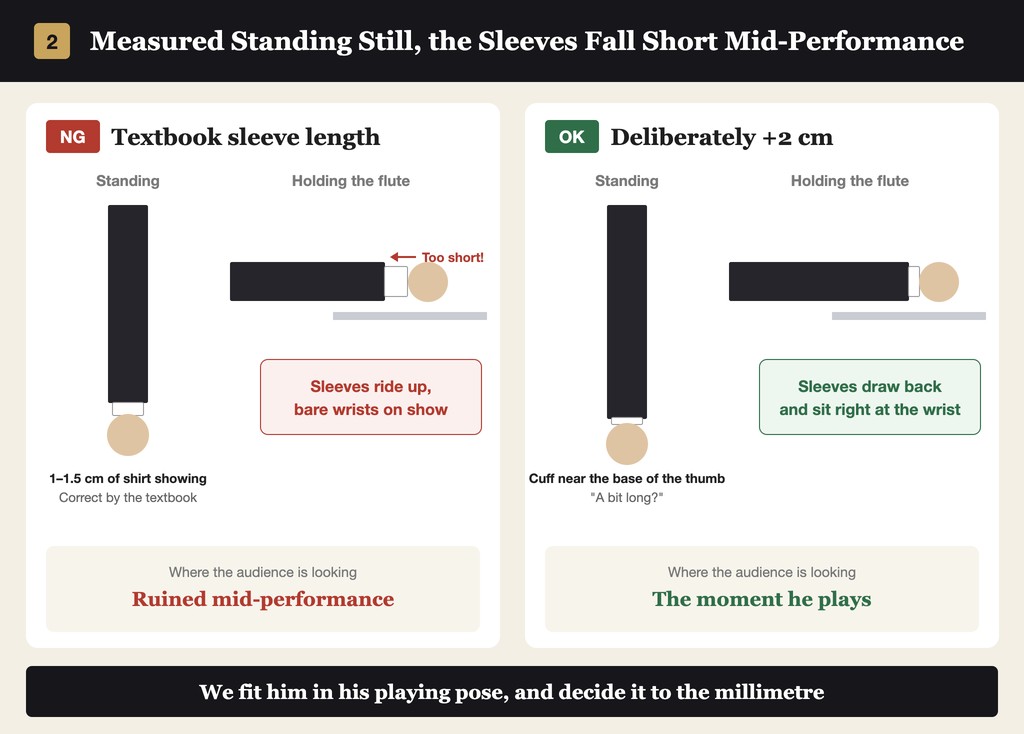
So what happens if you cut the sleeves to the “just right” length, with 1 cm of shirt showing while he stands up straight?
The moment he raises the instrument, the jacket sleeves ride up towards his upper arms, and either far too much shirt cuff shoots out, or, at worst, his bare wrists are on full view to the audience.
On stage, the audience’s eyes are drawn most of all to the musician at the very moment he’s playing. If his sleeves look a size too short right then, it doesn’t matter how expensive the cloth is. The whole look is ruined.
The Answer: Sleeves 2 cm Longer, and a Shallower Armhole
So I asked him to strike his playing pose, right there in the shop, as if he were holding his flute.
Checking the angle of his raised arms and moving fingers down to the millimetre, the answer I arrived at was this:
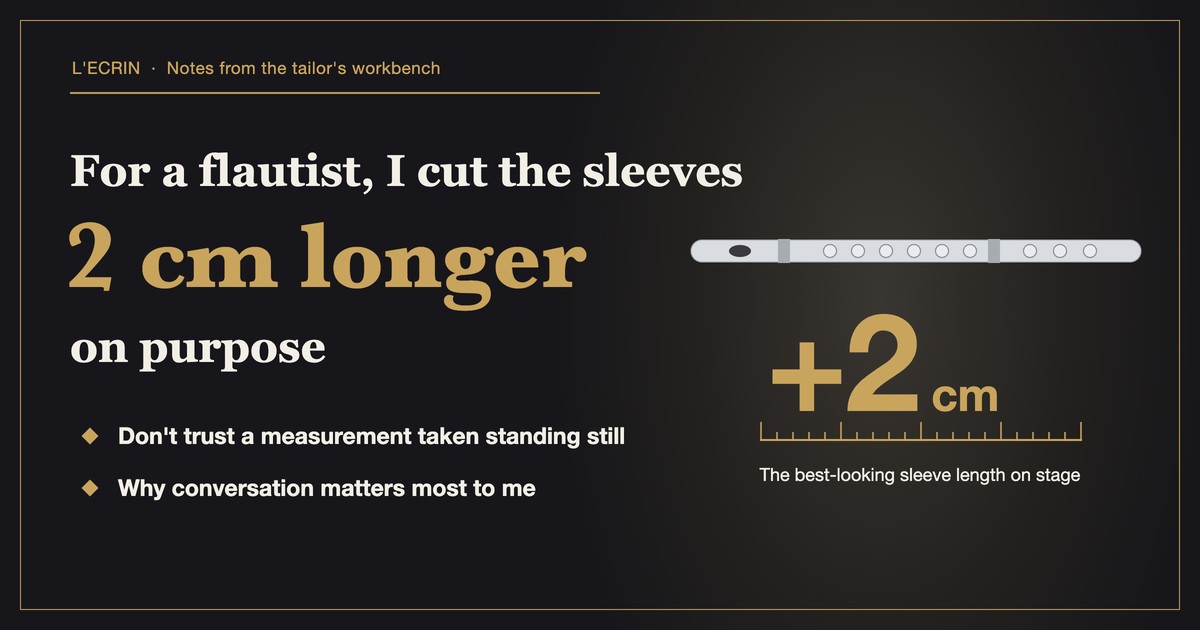
“Make the sleeves 2 cm longer than usual.”
That was my decision.
If you only looked at him standing to attention, the cuffs came down almost to the base of his thumbs, and you’d think, “Aren’t those sleeves a bit long?” For an everyday business suit, it’s a length I would never recommend to anyone.
But the moment he lifted his arms into position, the sleeves drew back and settled exactly where they should on his wrists, with the shirt cuff showing in perfect proportion.
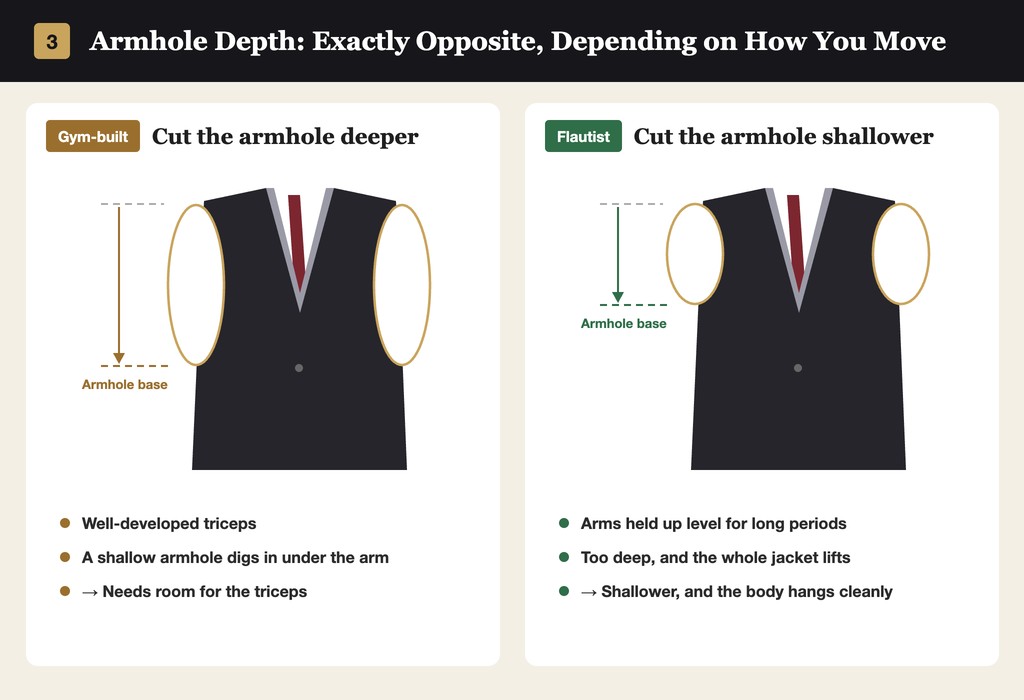
I also made one more important adjustment: I raised the armhole, making the scye (the depth from the shoulder down to the bottom of the armhole) shallower.
In fact, this is the exact opposite of what I do for men who lift weights.
People who train at the gym tend to have very developed triceps at the back of the upper arm. If you cut a shallow, high armhole for someone like that, those big triceps catch on the bottom of the armhole when he lowers his arms, and the underarm digs in until it’s unbearable. So a gym-built body needs room for the triceps to sit comfortably.
A flautist is the reverse. He holds his arms up high and level for long periods, so if the armhole is deep, with its base sitting low, the cloth under the arm gets pulled the moment he lifts them, and the whole body of the jacket rises up along with his arms.
By deliberately cutting the armhole snug and high, the body of the jacket isn’t dragged upwards however high he raises his arms. It stays put and hangs cleanly.
Fortunately, this customer had a fairly slim, average build. That’s exactly why a simple pair of adjustments, a higher armhole and longer sleeves, worked so dramatically. Had he been a flautist with big gym-built triceps… I would have needed a completely different approach, such as reshaping the curve of the armhole to give the triceps room while still keeping his arms free to move.
The goal is to capture the moment he is playing, when he should look his best and be able to perform without any strain at all.
This, to me, is the true essence of a made-to-measure suit, and something you will never reach by measuring to a standard manual.
Nobody Walks In and Says “It’s for Playing the Flute”
The more I do this job, the more I’m convinced that conversation is everything.
Customers don’t arrive with a technical brief like “Please make the sleeves the length that looks best when I’m playing the flute.” They just tell you the broad idea: “I want a black suit that looks good on stage.”
If I hadn’t really listened, and had simply said “Right, a black suit then,” put the tape measure on him and measured mechanically, I’d have handed him a suit that bared his wrists while he played and lifted the jacket every time he raised his arms. I’d have embarrassed him in front of an audience.
- What does he do for a living, and where will he wear it?
- How does his body move while he’s wearing it?
- Does he want to look his best standing, sitting, or in the moment he’s holding something up?
Over small talk and a cup of coffee, I take the time to draw out how someone lives and what they really want. That’s what makes it possible to suggest something made for that one person: “In that case, let’s lengthen the sleeves by 2 cm and raise the armhole.”
In Short: A Suit Is Made for a Living, Moving Body
A suit isn’t an ornament for a mannequin in a shop window. It’s a tool that people walk in, sit in, drive in and sometimes play music in, and its job is to make a living, moving body look its very best.
- Someone who types at a desk all day
- Someone who drives a lot and hates feeling tight across the shoulders
- Someone who steps into the spotlight on stage with an instrument in hand
A suit that doesn’t follow the way you actually stand and move day to day can’t be called the real thing, however much it costs.
“Off-the-peg suits just don’t work with the way I move at work.” “I want to look my very best on the big day, on stage.”
If that sounds like you, please come and talk to us at L’ECRIN in Sasa, Nagasaki. Through conversation, we’ll find the moment your body looks its best, together.
Related reading
Tailoring a Suit for a Former Bodybuilder with 65 cm Arms: The Customer Every Shop Had Turned Away
Why Do Men Who Train Hard End Up with Sloping Shoulders? Why Shoulder Position Is So Hard to Fix, and Why I Spend an Hour Listening
Why I Honestly Think Tailors Should Train Like Osteopaths: Guessing Jeans Sizes, and the Round Back with a Pigeon Chest
A suit made to your measurements
Sleeves, trouser hem, jacket length, shoulders and arms are all cut to your own body, not a size chart. Fittings are by appointment only. Tell us the dates you are in Japan and we will propose a time.