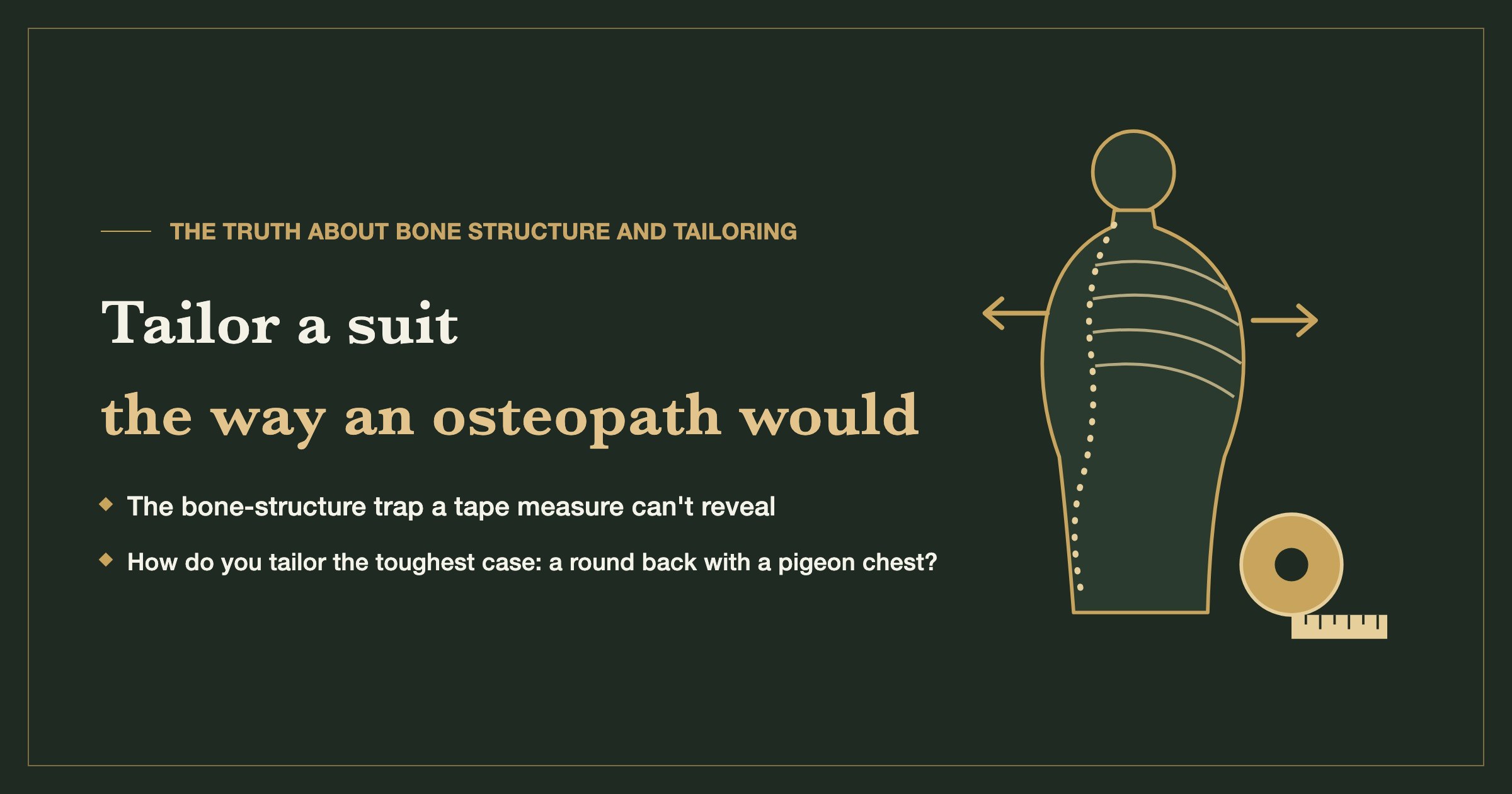
Years ago, at a shop where I used to work, a senior colleague would tell me this:
“Don’t ask the customer their size. Look at their body, hand them a pair of jeans that fits perfectly, and get them into it.”
Back then I honestly thought, “Come on, there’s no way anyone can tell that just by looking…” (laughs). But what he drilled into me at the time was this: “Nailing someone’s exact size is what makes you a professional, and that’s how you win fans. The brand on the sign matters, but become the kind of person people say they want to buy from.”
I was desperate just to keep up in those days, but twenty years on, that lesson has turned out to be incredibly useful. Once you’ve spent years looking at people’s bodies, you no longer need to ask their height or weight. The tilt of the skeleton and the way someone carries their weight just jump out at you.
That might sound a bit big-headed, but there are mountains of tailors out there more skilled and more impressive than me. Which is exactly why the craft is never finished, and why every day is still a learning day.
It’s a complete occupational hazard, but even now, walking around town on my day off, my eyes automatically follow the bone structure of everyone I pass. “Ah, he’s got really sloping shoulders.” “That walk says bow legs. His trouser creases are drifting outwards.” Before I know it, I’ve started a fitting in my head (laughs).
There was even a time, when I just couldn’t get to grips with a customer’s posture or the way their balance was off, that I went to an osteopath I knew and had him teach me how the skeleton is put together. That’s how much I believe you can never fully understand a body from the numbers a tape measure gives you, the circumferences alone.
The “Round Back with a Pigeon Chest”: The Most Awkward Build There Is
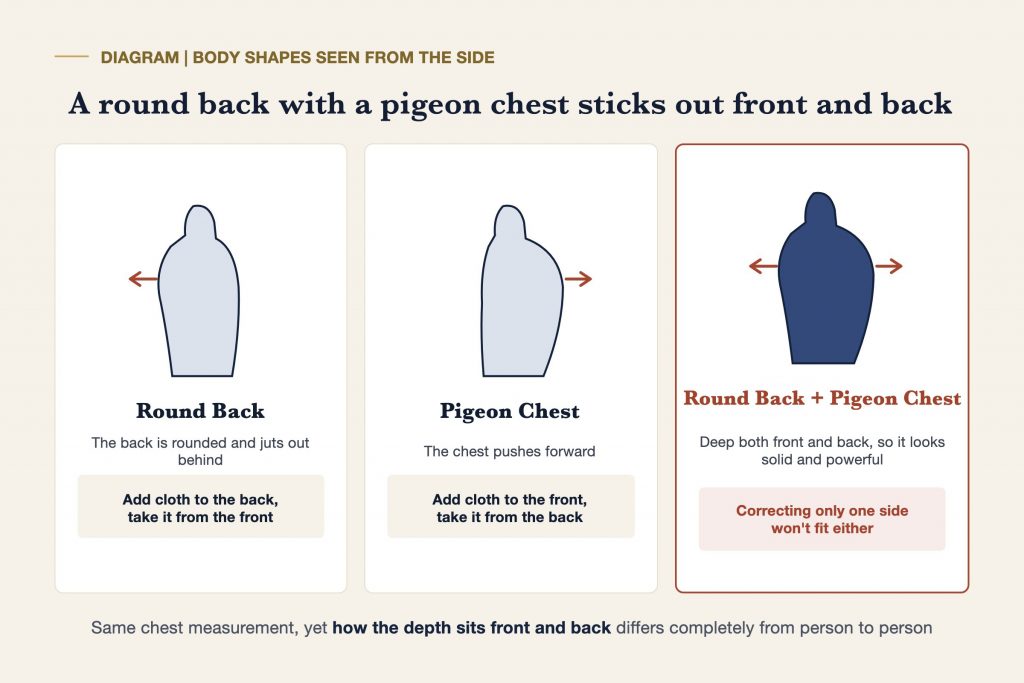
Speaking of what makes the human body so fascinating and so difficult, my own build is exactly that: a round back with a pigeon chest.
“How can your back be rounded and your chest stick out at the same time?” I know, right? Normally, the suit-making textbook thinks about it like this:
- A round back ➔ the back sticks out, so add cloth to the back and take some away from the front
- A pigeon chest ➔ the chest pushes forward, so add cloth to the front and take some away from the back
But with a round back and a pigeon chest, both the front and the back stick out. All that depth makes you look seriously solid at first glance. From the tailor’s side, though, there is no build more awkward, and none that tests your skill more.
How Made-to-Measure Goes Wrong When All You Do Is Measure
Take this build to a shop that decides everything from a tape measure around the chest, and this is usually what happens.
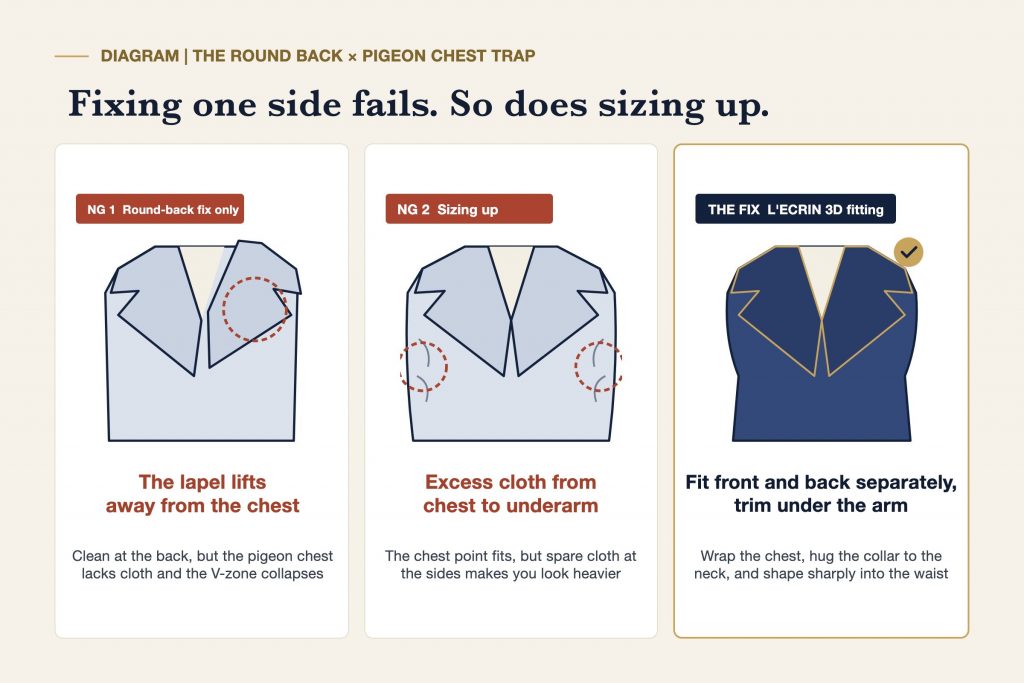
First, they put in a round-back adjustment only, “because the back is rounded”. The back then sits beautifully, but the pigeon chest pulls the cloth at the front, and the moment you button the jacket, the lapels lift and flap away from your chest.
“Well then, let’s go up a size so the chest fits.” Go up a size, and now the point of the chest fits, but the cloth from the chest down to the underarm is left baggy, full of pointless slack and creases.
Your body is strong and masculine, yet the clothes make you look like a heavier man wearing something that doesn’t fit.
Don’t Hide Your Build’s Quirks: Work with Them in Three Dimensions
So what do you do? The only way is to treat the forward chest and the rounded back as two separate shapes, and balance the front against the back.
- Build in enough ease to wrap gently around the forward chest
- Make the collar hug the back of the neck so the lapels never lift
- Yet cut away every bit of excess cloth under the arms, right to the limit
Fitted that way, the chest stays put without ever feeling tight, the sides are clean, and the depth of your own body turns straight into a good look.
Not a single person’s body is as straight as an off-the-peg mannequin. People whose shoulders have rolled forward from desk work, people whose seat sticks out from sport, people with strongly sloping shoulders. Whatever quirks you have, they are the history of the life you’ve lived, and there is nothing to be ashamed of.
What matters, I think, is whether you can make your clothes with someone who looks properly at the quirks of your build, not just the numbers on the tape measure.
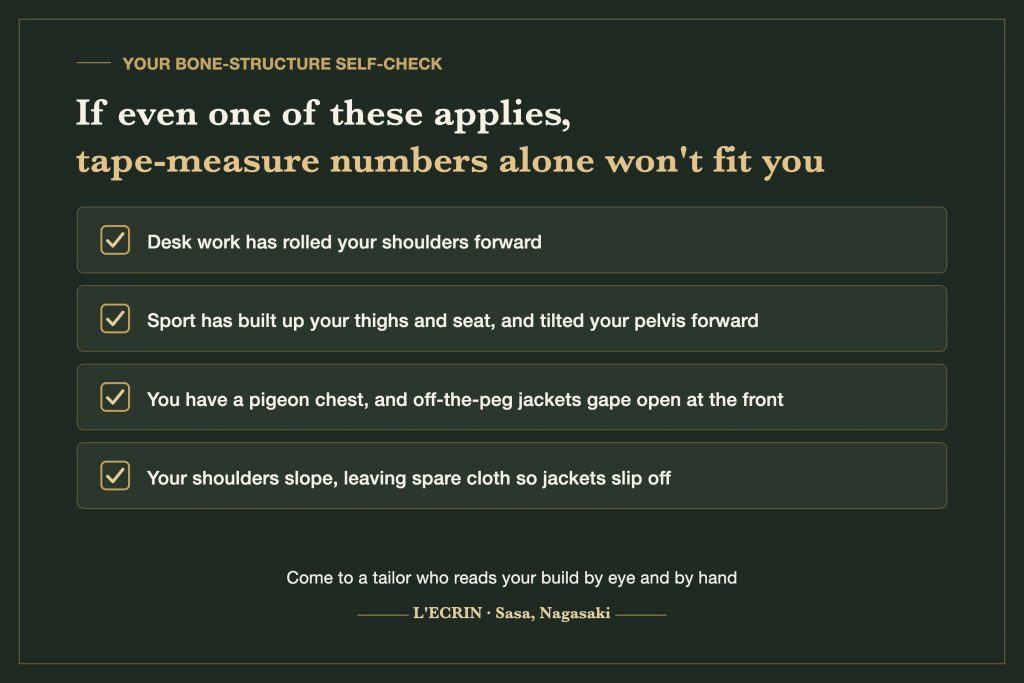
“Off-the-peg jackets always gape at the chest.” “Nothing I wear ever feels quite right on my build.”
If that sounds familiar, just drop in for a chat sometime. This tailor who spends his walks around town staring at bone structure (laughs) will work out with you the balance that suits your body best, without forcing it into anything.
Related reading
Why Do Men Who Train Hard End Up with Sloping Shoulders? Why Shoulder Position Is So Hard to Fix, and Why I Spend an Hour Listening
Why Your Jacket Back Lifts Into an “Inverted Triangle”: What Tailoring for a Boat Racer and a Pitcher Taught Me
Tailoring a Suit for a Former Bodybuilder with 65 cm Arms: The Customer Every Shop Had Turned Away
A suit made to your measurements
Sleeves, trouser hem, jacket length, shoulders and arms are all cut to your own body, not a size chart. Fittings are by appointment only. Tell us the dates you are in Japan and we will propose a time.