

You take your favourite suit out of the wardrobe after a while, and there it is: a small, neat hole.
Anyone who wears suits has probably felt that sinking feeling at least once. And at that moment, most people are struck by one very pointed question.
“Why is the cheap off-the-peg suit completely untouched, while the most expensive made-to-measure suit I own is the one that got eaten?”
Some people are genuinely shocked and ask me whether an expensive suit is made of weaker cloth than a cheap one. In fact, it is the exact opposite. The cloth is not weak at all.
In this post I want to explain what is really going on in your wardrobe, and share the simplest, cheapest care routine we use as professionals: one that takes creases out of a suit at home or on a business trip, without paying for dry cleaning.
Moths Are Gourmets: “100% Wool” Is a Feast
Let me give you the conclusion first. Clothes moths and carpet beetles will not eat synthetic fibres. What they truly love is fine, natural sheep’s wool.
- A 100% polyester suit: to an insect, this is just plastic. They will not give it a second look, and it is almost never eaten.
- A polyester-blend suit: because synthetic fibre is mixed in, the chance of it being eaten drops considerably.
- A fine 100% wool made-to-measure suit: this is a pure mass of natural amino acids, in other words protein, with nothing else mixed in. To an insect, it is like having the finest marbled steak placed right in front of it.
So if it is always your expensive suits that get eaten, that is proof that the cloth is genuine, high-quality, unblended wool.
Which is exactly why the better the suit, the less you can afford to leave it unprotected in the wardrobe. Garment bags and moth repellent are a given, of course, but even more important is how you look after it day to day and how you deal with dirt.
“Dry Clean It as Soon as It’s Dirty” Shortens a Suit’s Life
When it comes to suit care, a great many people believe that sending it to the dry cleaner’s often is the cleanest way to make it last.
I will be blunt. Dry cleaning too often wears the cloth out.
Dry cleaning does not use water; it uses petroleum-based solvents, which are strong chemicals. They do remove the dirt, but at the same time they strip out the natural oils that wool holds, the very barrier that keeps it supple and gives it its lustre. Send a suit off again and again, and the cloth turns dry and thin, loses its body, and its life is cut dramatically short.

How a Tailor Really Makes a Suit Last
So what should you do day to day? You do not need to spend any money. These simple rules are all it takes.
1. Everyday care: a light mist of water and a night hanging in the shade
100% wool cloth breathes, and when it takes on moisture it has a remarkable ability to spring back to its original shape. If, after a day’s wear, you notice creases or odours, simply give it a light spray of water from a mist bottle and hang it overnight somewhere shaded and well ventilated. As the moisture evaporates, the fibres naturally plump up and the creases fall out, and the smell of sweat or cigarette smoke is carried away with it.
2. Send it to the cleaner’s when the collar and cuffs start to look grubby
A mist of water is enough most of the time, but once the area around the jacket collar or the inside of the cuffs starts to look faintly dirty, send it to the cleaner’s without hesitation. Leave skin oil and sweat in place and they oxidise into stubborn yellow sweat stains. Once a stain has set, it will never come out properly again.
3. As a rule, clean once at the end of the season, then store
Day to day, keep a rotation going with a mist of water, a rest between wears and a good brushing, and send it for a proper clean once, when you swap your wardrobe over at the end of the season in spring or autumn. Then store it, with all the skin oil completely reset, alongside some moth repellent. That is the golden cycle for keeping a beautiful lustre for years without damaging the cloth.
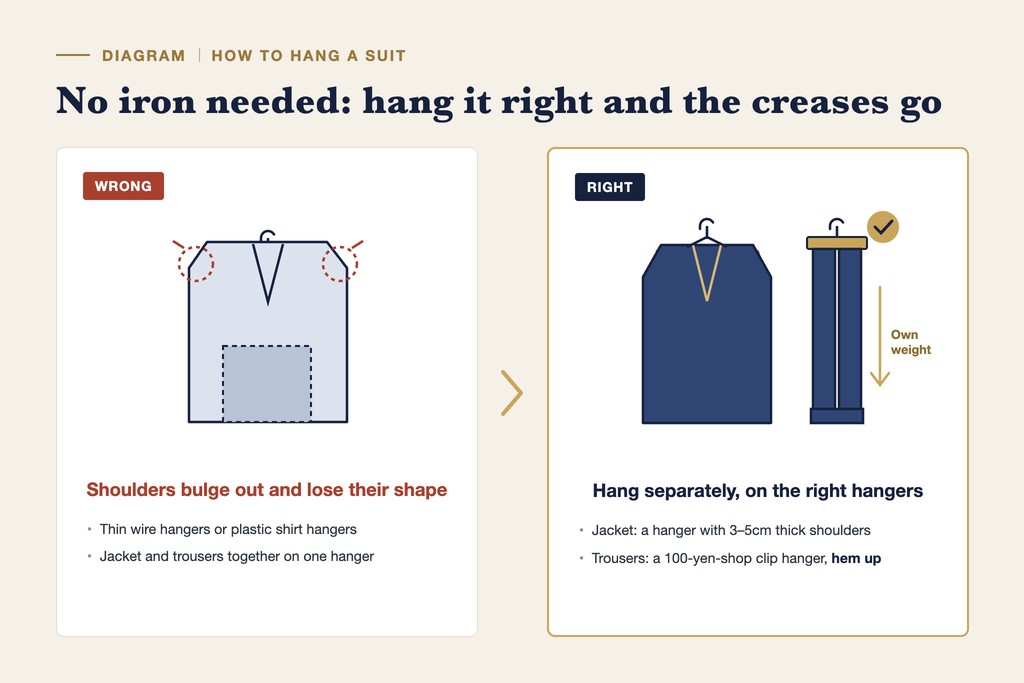
The Secret of the Hanger: Hang Trousers Hem Up and Let Their Own Weight Remove the Creases
Finally, how you hang your suit after taking it off each day. Here too there is a professional trick for getting rid of creases without an iron.
Rule 1: Hang the jacket and trousers separately
Please never hang the jacket and trousers together on one hanger, the way they come back from the cleaner’s. Moisture gets trapped, and the weight pulls the suit out of shape.
Rule 2: Give the jacket a hanger with proper shoulders
Hang a jacket on a thin wire hanger or a plastic shirt hanger, and unnatural pressure falls on the shoulder pads and seams, leaving a mark that will not come out: the tips of the shoulders bulge out as if something were poking through. Always use a proper jacket hanger with solid, broad ends at the shoulders, around 3–5cm thick.
Rule 3: Hang trousers upside down on a cheap clip hanger
There is no need to buy an expensive hanger. A clip-style trouser hanger from a 100-yen shop (Japan’s equivalent of a pound shop) does the job perfectly well.
The key is to hang them upside down: hems at the top, waistband at the bottom. The waistband, with its interlining, buttons and fastenings, is the heaviest part of a pair of trousers. Clip the hems and hang them upside down, and the weight of the waistband gently pulls the whole cloth straight down, so the creases from wearing them simply ease out on their own. By the next time you put them on, the creases will have vanished as though they had been pressed.
A Hotel-Room Trick for Creases Behind the Knees
Hanging trousers upside down works wonders in a hotel room on a business trip or holiday, too.
After a long journey by bullet train or plane, or hours at a desk, deep seated creases set in behind the knees and around the seat of your trousers.
When that happens:
- Clip the hems of your trousers to the hotel’s clip hanger and hang them upside down
- Lightly dampen the creased areas behind the knees and around the seat with a mist bottle (or, if you don’t have one, the steam from the shower will do)
That is all. By the next morning, the combined effect of the weight and the evaporating moisture will have made those deep creases all but disappear. No need to go and borrow an iron.
In Conclusion: Know How to Care for It, and Your Suit Becomes a Trusted Companion
Making a suit last does not call for expensive tools or troublesome maintenance.
- The finer the cloth, the more insects love it, so be thorough about end-of-season storage
- Don’t over-rely on dry-cleaning chemicals; day to day, restore it with water and its own weight (hanging upside down)
- Hang the jacket and trousers separately, and let them rest on the right hangers
Knowing just these few things can make your suit last two or three times longer, and keep it looking as clean and sharp from behind as the day it was made, year after year.
“My suits keep creasing and I don’t know how to look after them.” “I want to keep wearing the suits I already own, well, for years to come.”
If you have questions or worries like these about caring for your suits, please feel free to get in touch with L’ECRIN in Sasa, Nagasaki at any time, even if you have no plans to order a suit. I will gladly share everything I know to help the suit you had made stay your best companion for many years to come.
Related reading
The Great Misconception That a Made-to-Measure Suit Lasts Forever: British vs Italian Cloth, and What Decides a Ten-Year Lifespan
The Myth of the “All-Season” Suit: What Cloth Weight Really Tells You, and the Art of the Summer Waistcoat
A suit made to your measurements
Sleeves, trouser hem, jacket length, shoulders and arms are all cut to your own body, not a size chart. Fittings are by appointment only. Tell us the dates you are in Japan and we will propose a time.